Artificial Intelligence, zBlog
AI Tech Stack 2026: What the Modern Enterprise AI Architecture Looks Like
Team Trantor | Updated: August 21, 2026
What is an AI tech stack?
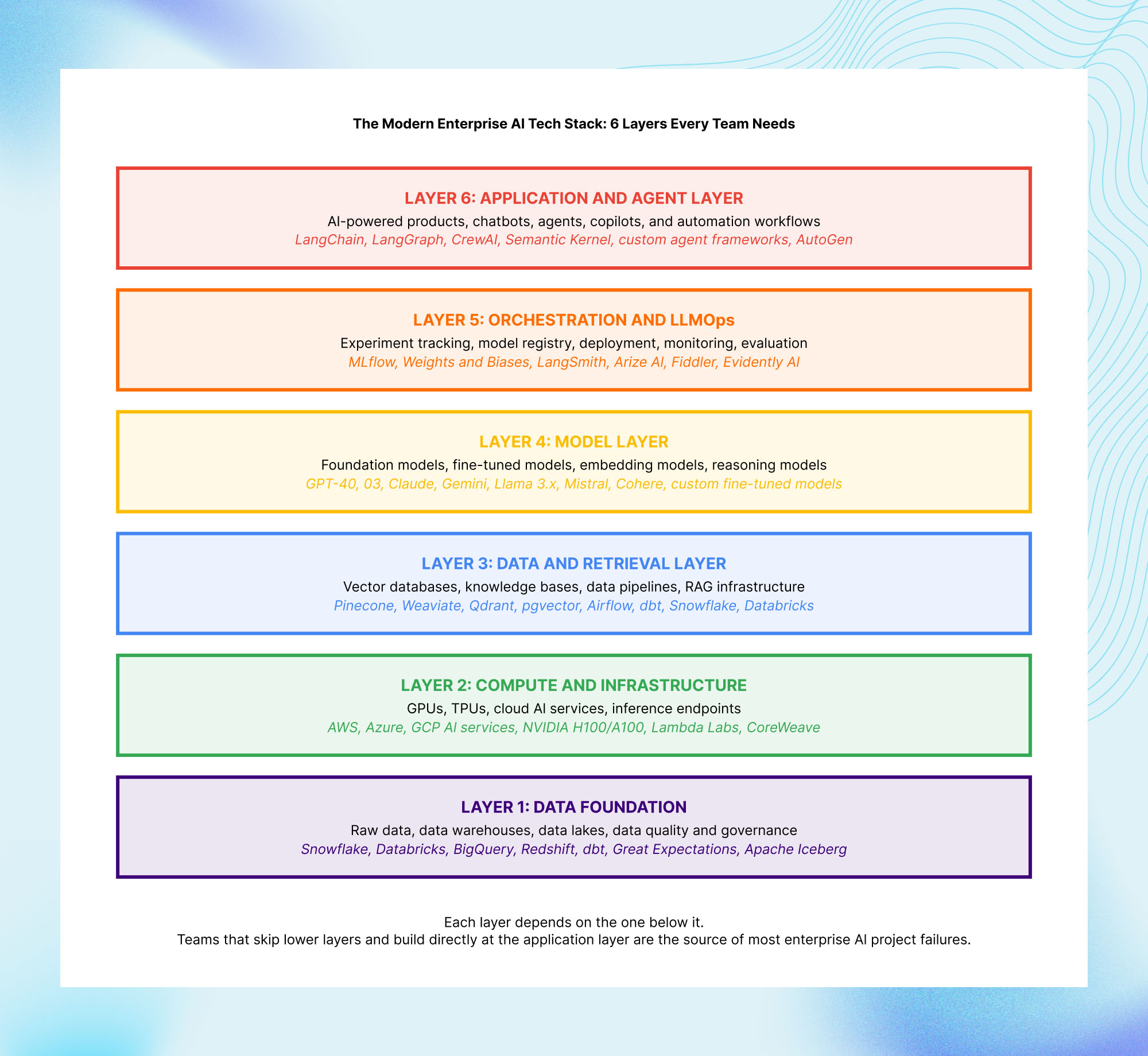
An AI tech stack is the combination of tools, infrastructure, and frameworks that an organization uses to build, deploy, and operate AI-powered applications. The modern enterprise AI tech stack has six distinct layers: a data foundation, compute and infrastructure, a model layer, a data and retrieval layer (including vector databases and RAG pipelines), an orchestration and LLMOps layer, and an application and agent layer.
78 percent of enterprises now have some form of AI tech stack in production, according to McKinsey’s 2026 Global AI Survey. What that figure does not capture is how many of those stacks are incomplete, poorly sequenced, or missing critical layers that will cause problems as the organization tries to scale. The most common pattern in enterprise AI today is organizations that have built directly at the application layer, standing up a chatbot or a copilot, without first establishing the data foundation and LLMOps infrastructure that would make that application reliable, observable, and maintainable over time.
This guide is a layer-by-layer breakdown of the modern enterprise AI tech stack in 2026. It covers every layer from raw data through production agents, the specific tools that have become standard at each level, the common mistakes that cause AI tech stack projects to fail, the sequence in which layers should be built, and how the right stack changes as organizations move from early experimentation to production scale. If you are a CTO, engineering leader, or AI architect evaluating your organization’s AI tech stack, this is the vendor-neutral reference you need before making significant infrastructure investments.
The AI tech stack is not a single product you buy or a single decision you make. It is a set of layered architectural decisions where each layer depends on the quality of the layer below it. Organizations that rush to the application layer without a clean data foundation, appropriate compute infrastructure, and observability tooling are building on sand, and the problems that creates show up six to twelve months after initial deployment, not during the first demo.
The Modern Enterprise AI Tech Stack: A 6-Layer Architecture
The modern enterprise AI tech stack can be understood as six distinct horizontal layers, each providing specific capabilities that the layers above it depend on. This layered model is not unique to AI, it mirrors how mature engineering organizations think about web infrastructure, data platforms, and security architecture. What makes the AI tech stack distinctive is how new all six layers are and how quickly the tooling at each level is evolving.
Layer 1: The Data Foundation of Your AI Tech Stack
The data foundation is everything your AI tech stack depends on but often receives the least attention. Raw data from operational systems, data warehouses, data lakes, and external sources must be accessible, clean, well-documented, and governed before any meaningful AI application can be built on top of it. Organizations that skip or underinvest in this layer discover the problem when their AI applications produce inconsistent results, when their vector databases are populated with low-quality embeddings, or when their fine-tuned models behave unpredictably because the training data was poorly curated.
Key tools in 2026: Snowflake, Databricks, Google BigQuery, Amazon Redshift for warehousing. Apache Iceberg for open table format. dbt for transformation and documentation. Great Expectations or Soda for data quality validation. Apache Airflow or Prefect for pipeline orchestration.
The data foundation layer of the AI tech stack requires answering four questions before any AI work begins. Where does the data actually live, and is it accessible? What is the quality and completeness of the data, and has anyone formally assessed it? Who owns and can authorize use of each dataset for AI training and inference? And is the data governance framework, including privacy controls and compliance documentation, adequate for the intended AI use cases? Organizations that cannot answer these questions have a data foundation problem, not an AI problem, and adding AI tooling on top of an unresolved data foundation problem accelerates the pain rather than delivering value.
Layer 2: Compute and Infrastructure in the Enterprise AI Tech Stack
The compute layer of the AI tech stack determines what AI capabilities are financially feasible and how quickly they can be accessed. Most enterprise AI tech stacks in 2026 use a combination of managed cloud AI services for the majority of inference workloads and dedicated GPU capacity for training, fine-tuning, and high-volume inference where the economics of dedicated infrastructure justify the operational overhead.
Key tools in 2026: AWS (Bedrock, SageMaker), Azure (AI Studio, OpenAI Service), Google Cloud (Vertex AI) for managed AI services. NVIDIA H100 and A100 GPUs for dedicated compute. CoreWeave and Lambda Labs for GPU cloud alternatives. NVIDIA TensorRT and vLLM for inference optimization.
The compute layer decision that matters most for most enterprise AI tech stacks is not which GPU cluster to buy. It is which cloud AI service to use as the primary API access point for LLM inference, because this decision affects pricing, latency, model selection, data residency, and compliance. AWS Bedrock, Azure AI Studio, and Google Vertex AI each provide managed access to multiple foundation models alongside their proprietary model offerings, with different pricing structures, latency characteristics, and regional availability. For regulated industries, data residency requirements often drive this decision more than technical performance metrics.
COST MONITORING IS NOT OPTIONAL: The compute layer of the AI tech stack is where enterprise AI cost surprises happen. LLM API costs scale with token volume in ways that are genuinely difficult to predict from pilot usage patterns, and inference costs for reasoning models like o3 can be 10 to 30 times higher per query than standard models. Any AI tech stack deployment that does not include cost monitoring with budget alerts from day one is going to produce a financial surprise within the first 90 days of real user traffic.
Layer 3: The Data and Retrieval Layer (RAG Infrastructure)
The data and retrieval layer is where the AI tech stack gets its ability to work with your organization’s specific knowledge rather than only the general knowledge baked into foundation model weights. This layer includes vector databases that store embeddings of your documents and data, the embedding models that convert text into those vectors, the retrieval pipelines that find relevant context at query time, and the reranking systems that improve retrieval precision. Retrieval Augmented Generation (RAG) is the dominant pattern for giving LLMs access to organization-specific knowledge in 2026, and the quality of this layer is the primary determinant of whether a RAG-powered AI application is actually useful.
Key tools in 2026: Pinecone, Weaviate, Qdrant, Chroma for vector databases. pgvector for Postgres-native vector storage. OpenAI or Cohere embedding models. LlamaIndex for retrieval pipeline orchestration. Reranking with Cohere Rerank or cross-encoder models.
The retrieval layer of the AI tech stack is where most RAG implementations fail in practice. The typical failure mode is an organization that builds a working RAG prototype, discovers that retrieval quality degrades significantly when the real document corpus is loaded (rather than the clean demo dataset), and cannot diagnose why without proper retrieval evaluation tooling in place. Retrieval quality depends on embedding model selection, chunking strategy, metadata filtering, hybrid search configuration (combining keyword and semantic search), and reranking, all of which require deliberate design and evaluation rather than default settings.
RAG QUALITY NOTE: The most important investment in the retrieval layer of your AI tech stack is an evaluation framework for retrieval quality, not the vector database choice. RAGAS, TruLens, and similar RAG evaluation tools allow you to systematically measure whether your retrieval is actually returning the context that answers your users’ questions. Without this measurement, you will not know whether retrieval quality improvements are helping until user complaints reach a threshold.
Layer 4: The Model Layer of the Enterprise AI Tech Stack
The model layer is where most AI tech stack conversations begin, and it is actually one of the most mature and commoditized layers in 2026. The foundation models available through API access, GPT-4o, Claude, Gemini, Llama 3.x, Mistral, and their reasoning model variants, are sufficiently capable that model selection is rarely the binding constraint on enterprise AI application quality. The binding constraints are almost always in the layers below the model. That said, model selection does matter for specific use cases, pricing, data residency requirements, and the need for fine-tuning.
Key tools in 2026: GPT-4o and o3 (OpenAI), Claude Sonnet and Opus (Anthropic), Gemini 1.5 Pro and 2.0 (Google), Llama 3.1 and 3.3 (Meta, self-hosted), Mistral Large (Mistral AI), Command R+ (Cohere). Embedding models: OpenAI text-embedding-3-large, Cohere embed-v3, Nomic embed.
Standard models vs reasoning models: the AI tech stack in 2026 typically requires both. Standard models (GPT-4o, Claude Sonnet, Gemini Flash) handle high-volume, lower-complexity tasks at lower cost and latency. Reasoning models (o3, Claude Extended Thinking) are reserved for complex analytical tasks where accuracy justifies the 10 to 30x cost and latency premium. A mature AI tech stack routes queries to the appropriate model tier rather than using the most expensive model for every task.
Fine-tuning vs RAG: for most enterprise use cases, RAG with a well-configured retrieval layer outperforms fine-tuning and requires far less investment to maintain. Fine-tuning is worth the investment when the organization needs the model to adopt a consistent style or vocabulary, when latency requirements make RAG retrieval too slow, or when the use case requires capabilities that prompting cannot deliver. Fine-tuning is not a substitute for a well-designed retrieval layer.
Open source vs proprietary: Llama 3.x from Meta and Mistral models are now strong enough for many enterprise use cases and can be self-hosted for data residency, cost, or customization reasons. The operational overhead of self-hosted model serving, including GPU infrastructure management, model updates, and inference optimization, is significant and should be compared honestly against the fully managed cost of proprietary model APIs before choosing self-hosting.
Layer 5: Orchestration and LLMOps in the AI Tech Stack
The LLMOps layer is the most commonly missing piece of the enterprise AI tech stack and the one most responsible for AI projects that work in demos but fail in production. LLMOps covers experiment tracking (which prompts, models, and configurations produce the best results), model and prompt versioning (so changes can be rolled back), evaluation frameworks (systematic measurement of output quality), production monitoring (detecting when the application is producing wrong or degraded outputs), and hallucination detection. Without this layer, the AI tech stack has no visibility into whether its applications are actually working correctly at any given moment.
Key tools in 2026: MLflow or Weights and Biases for experiment tracking. LangSmith for LangChain application tracing. Arize AI or Fiddler for LLM monitoring. Evidently AI or RAGAS for evaluation. Helicone or Langfuse for LLM observability. Phoenix (Arize) for open-source observability.
The LLMOps layer of the AI tech stack is the engineering discipline that ensures your AI application behaves correctly not just at launch but six months and a year after launch, when prompt distributions shift, when model providers update their underlying models, and when your document corpus changes in ways that degrade retrieval quality. McKinsey research on enterprise AI found that organizations with mature MLOps practices are 3x more likely to report positive AI ROI than those without, and this finding holds for LLMOps specifically in LLM-based applications.
THE MOST COMMON AI TECH STACK MISTAKE: Deploying an LLM application without a monitoring and evaluation layer is the single most common technical mistake in enterprise AI tech stacks. The failure mode is quiet: the application appears to work, users start relying on it, and then six weeks later a model provider pushes an undocumented model update, or retrieval quality degrades because new documents were added without re-embedding, and nobody knows until user complaints reach a threshold. Production LLM monitoring is not optional infrastructure. It is the difference between an AI application you can trust and one you are holding your breath about.
Layer 6: The Application and Agent Layer
Layer 6: Application and Agent Layer
The application and agent layer is where the AI tech stack produces visible value: the chatbots, copilots, document analysis tools, autonomous agents, and workflow automation systems that users actually interact with. In 2026, this layer increasingly means agentic systems rather than simple chat interfaces: AI agents that can take multi-step actions, call external tools and APIs, maintain state across long workflows, and coordinate with other agents to complete complex tasks.
Key tools in 2026: LangChain and LangGraph for Python agent development. CrewAI for role-based multi-agent systems. Semantic Kernel for Microsoft-stack enterprise. AutoGen for agentic coding and research. Vercel AI SDK for JavaScript/TypeScript applications. Custom agent frameworks for proprietary workflows.
The application layer of the AI tech stack is the most visible and the most likely to receive organizational attention and investment. The paradox is that it is also the layer that provides the least leverage for most organizations in 2026. If the data foundation is poor, the retrieval layer is misconfigured, and the LLMOps layer is absent, no amount of application-layer sophistication will produce a reliable, trustworthy AI product. The application layer is where value is delivered, but it is the last place to invest, not the first.
The most significant shift at the application layer in 2026 is the move from single-turn LLM calls to stateful, multi-step agent workflows. LangGraph, CrewAI, and similar frameworks enable AI agents that maintain state across many steps, coordinate with specialized sub-agents, and take actions in external systems through tool calls and API integrations. Building production-grade agent systems requires significantly more engineering rigor than building a simple chat interface, including explicit state management, error recovery logic, human escalation pathways, and observability that can trace exactly what an agent did across a multi-step workflow.
Tool Adoption Across the Enterprise AI Tech Stack
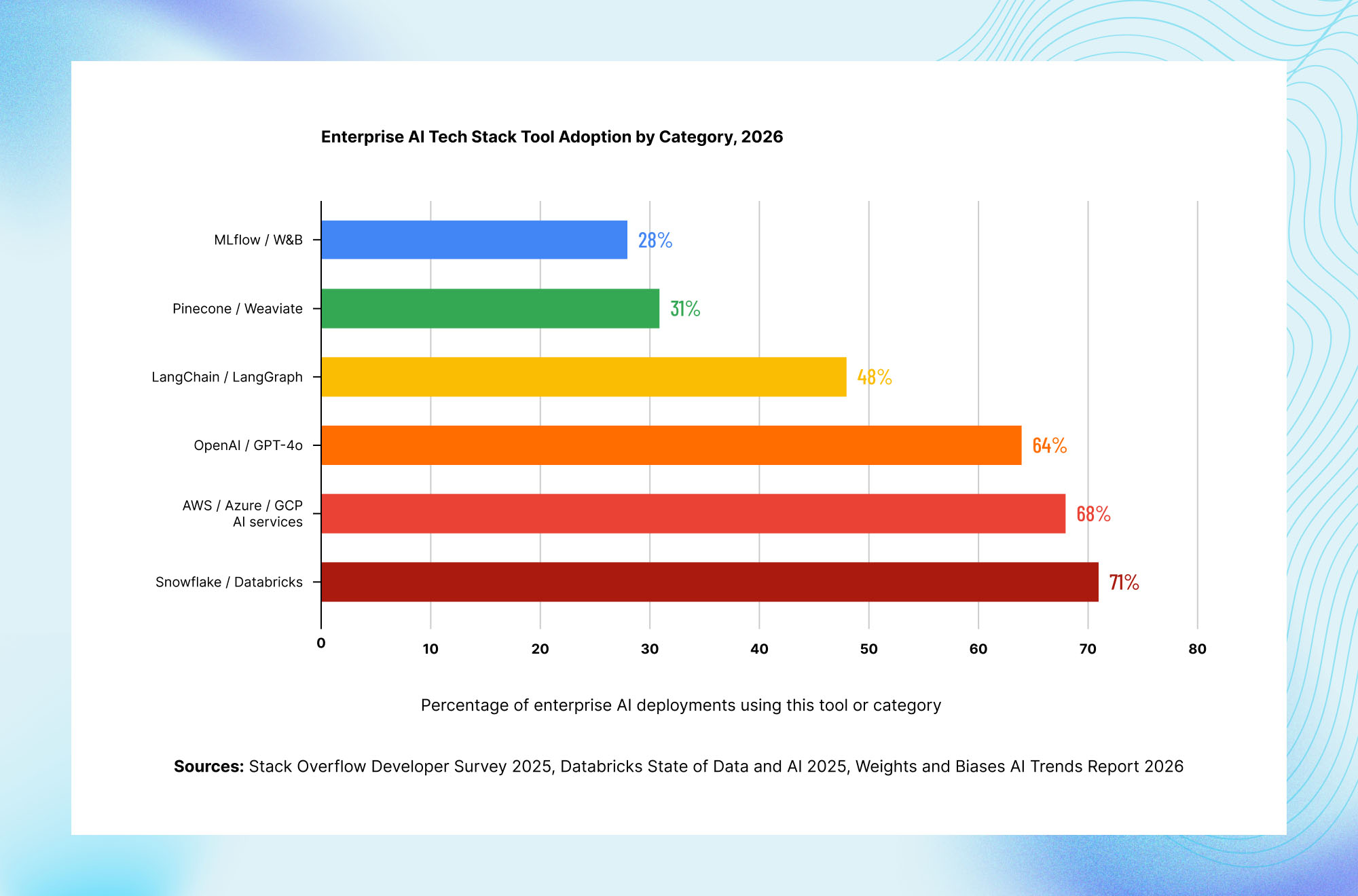
Tool adoption across the enterprise AI tech stack is heavily front-loaded toward the data and model layers. Snowflake and Databricks are used in roughly 71 percent of enterprise AI deployments, reflecting their position as the data foundation that most AI projects are built on. Cloud AI services from AWS, Azure, and GCP appear in 68 percent, reflecting how thoroughly managed AI APIs have replaced self-hosted model infrastructure for most enterprise use cases. OpenAI’s GPT-4o is the most widely used foundation model at 64 percent.
The adoption gap that reveals where most AI tech stacks are incomplete is in the LLMOps layer. MLflow and Weights and Biases appear in only 28 percent of deployments, and vector database adoption at 31 percent indicates that many organizations are using LLMs without a proper retrieval infrastructure. These are exactly the layers that IDC identifies as missing in the 42 percent of enterprise AI projects that fail before reaching stable production.
How to Build Your AI Tech Stack: The Right Sequence
The most consequential decision in enterprise AI tech stack development is the order in which layers get built. The wrong sequence, which is common because application-layer demos are the most visible and politically compelling deliverables, is to start at Layer 6 and try to fill in the lower layers retroactively. The right sequence builds from the foundation up.
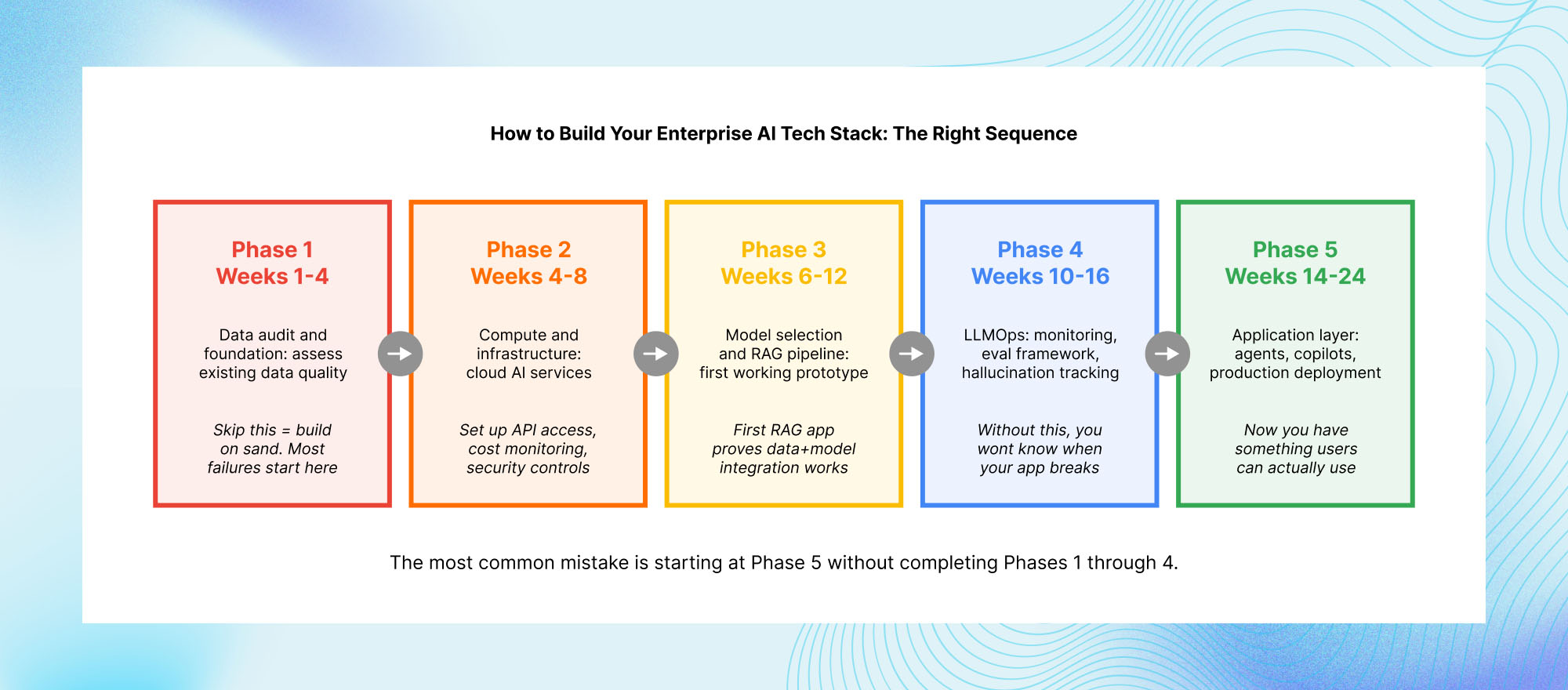
Why sequence matters: each phase of AI tech stack development validates assumptions that the next phase depends on. A data audit in Phase 1 reveals whether the quality and structure of available data can actually support the AI use case being planned. An early RAG prototype in Phase 3 tests whether data plus model integration produces useful outputs before large investments in production infrastructure. Skipping to Phase 5 without completing these validations means discovering fundamental problems at the worst possible time, when production infrastructure is in place and users are depending on the application.
AI Tech Stack by Organizational Maturity
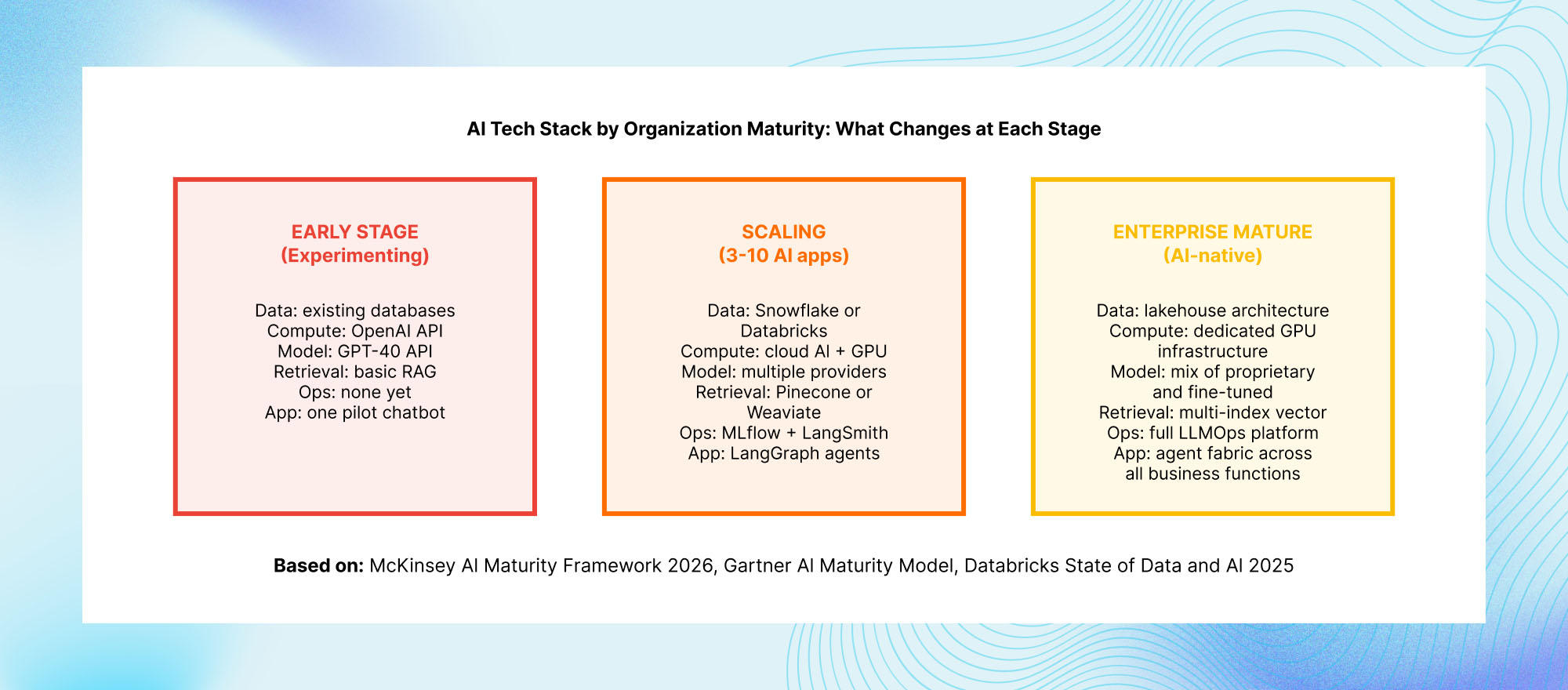
The right AI tech stack for an organization depends significantly on where it is in its AI maturity journey. Early-stage organizations experimenting with their first AI use cases have fundamentally different infrastructure needs from organizations running AI natively across their business functions, and investing in a mature enterprise AI tech stack before the organization has the processes and skills to operate it creates complexity without value.
Early-stage AI tech stack: organizations in the experimentation phase typically start with their existing databases as the data foundation, access LLMs through managed APIs (OpenAI, Anthropic, or Google directly rather than cloud platform intermediaries), implement basic RAG with a managed vector database like Pinecone, and have minimal LLMOps beyond logging. This is appropriate for the phase and should not be criticized for its simplicity. The goal at this stage is to validate use cases and build organizational AI capability, not to build production-grade infrastructure.
Scaling AI tech stack: once an organization has three to ten working AI applications, the gaps in the early-stage stack become genuine operational problems. Data management at this scale requires Snowflake or Databricks. Retrieval quality requires a more sophisticated vector database and evaluation framework. Multiple model providers and cost optimization require a model routing layer. LLMOps becomes mandatory rather than optional as multiple teams are modifying AI applications simultaneously.
Enterprise-mature AI tech stack: organizations that are running AI natively across their business functions have typically evolved toward a lakehouse architecture for data, dedicated or reserved GPU infrastructure for high-volume inference, a mix of proprietary and fine-tuned models for different use cases, a multi-index vector retrieval system, a full LLMOps platform with evaluation and monitoring, and an agent orchestration layer coordinating AI workflows across multiple business systems. This level of investment is only justified when the AI applications it supports are generating commensurate business value.
Common AI Tech Stack Mistakes and How to Avoid Them
Building at the application layer before establishing the data foundation: the most common AI tech stack mistake. An AI chatbot built on poorly structured, inconsistently formatted data will hallucinate and produce unreliable outputs regardless of how capable the underlying model is. Fix: complete a data audit and establish data quality standards before the first AI prototype.
Choosing tools by brand recognition rather than use-case fit: the AI tech stack tool landscape is marketed aggressively and brand recognition does not predict fit. Pinecone is an excellent vector database for specific use cases and genuinely wrong for others. MLflow and Weights and Biases overlap significantly and choosing both creates confusion rather than coverage. Fix: define the specific capability needed at each layer before evaluating tools, rather than evaluating tools and then figuring out what to use them for.
Skipping the LLMOps layer entirely: the 42 percent AI project failure rate from IDC is dominated by projects that never established monitoring and evaluation. Without observability, teams discover production problems through user complaints rather than through their own detection systems. Fix: instrument LLM calls with tracing from day one, even if the initial monitoring is basic. Retrofitting observability into a production AI application is significantly harder than including it from the start.
Using reasoning models for everything: o3 and Claude Extended Thinking are significantly more expensive and slower than standard models, and the accuracy improvement only materializes on tasks that require complex multi-step reasoning. Using reasoning models for writing, summarization, and customer service chat inflates cost without improving quality. Fix: design explicit model routing that directs queries to the appropriate model tier based on task complexity.
Treating vendor lock-in as a secondary concern: AI tech stack components, particularly managed vector databases and cloud AI services, create significant switching costs once production data is loaded and applications are built on their APIs. Fix: design data portability from the start. Store source documents and embeddings separately so the vector database can be replaced without re-processing source content. Use abstraction layers in application code that allow model providers to be swapped without rewriting integration logic.
Frequently Asked Questions About the Enterprise AI Tech Stack
Q: What components make up an enterprise AI tech stack?
The modern enterprise AI tech stack has six layers. Layer 1 is the data foundation, covering data warehouses, data lakes, and data quality tools. Layer 2 is compute and infrastructure, including cloud AI services and GPU capacity. Layer 3 is the data and retrieval layer, covering vector databases and RAG pipelines. Layer 4 is the model layer, covering foundation model selection and fine-tuning. Layer 5 is the LLMOps layer, covering experiment tracking, monitoring, and evaluation. Layer 6 is the application and agent layer, covering the AI-powered products and workflows that users interact with.
Q: What is LLMOps and why does the AI tech stack need it?
LLMOps is the operational discipline for running large language model applications reliably in production. In the context of the AI tech stack, LLMOps covers experiment tracking for prompts and model configurations, versioning so changes can be rolled back, evaluation frameworks for systematic output quality measurement, production monitoring to detect when applications are producing degraded or incorrect outputs, and hallucination detection. Without LLMOps, an AI tech stack has no visibility into whether its applications are working correctly after initial deployment. McKinsey research found that organizations with mature LLMOps practices are 3x more likely to report positive AI ROI.
Q: What tools are most commonly used in the enterprise AI tech stack?
The most widely adopted tools in enterprise AI tech stacks in 2026 are Snowflake or Databricks for data foundation (71% adoption), AWS, Azure, or Google Cloud AI services for compute (68%), OpenAI GPT-4o for the model layer (64%), LangChain or LangGraph for application orchestration (48%), Pinecone or Weaviate for vector databases (31%), and MLflow or Weights and Biases for LLMOps (28%). The low adoption of LLMOps and vector database tools relative to model and data layer tools reflects the infrastructure gap that causes 42% of enterprise AI projects to fail before stable production.
Q: Should enterprises build or buy their AI tech stack?
The practical answer for most enterprises in 2026 is a hybrid: buy managed services at the infrastructure layers and build at the application layer. Cloud AI services (AWS Bedrock, Azure AI Studio, Google Vertex AI) and managed vector databases (Pinecone, Weaviate Cloud) provide the compute and retrieval infrastructure without the operational overhead of self-hosting. The application and agent layer, where competitive differentiation actually happens, is where building with frameworks like LangGraph and CrewAI provides proprietary capability that cannot be replicated with off-the-shelf tools.
Q: How much does an enterprise AI tech stack cost?
Enterprise AI tech stack costs vary enormously based on scale, use cases, and tooling choices. A small organization with one or two AI applications running moderate traffic might spend $5,000 to $20,000 per month across all layers. A mid-market enterprise with 10 to 20 AI applications in production typically spends $50,000 to $200,000 per month, with inference costs as the largest variable. Large enterprises running AI natively across multiple business functions can spend millions per month. The most important cost management practice is implementing cost monitoring and budgets at the compute layer before any significant user traffic begins, and using model routing to direct queries to cost-appropriate model tiers based on complexity.
Q: What is a RAG pipeline and why is it part of the AI tech stack?
RAG stands for Retrieval Augmented Generation. A RAG pipeline is the infrastructure component of the AI tech stack that allows a foundation model to answer questions based on your organization’s specific documents and data rather than only its general training knowledge. Documents are converted to numerical vector representations using an embedding model and stored in a vector database. When a user submits a query, the RAG pipeline retrieves the most relevant document chunks from the vector database and includes them in the prompt sent to the LLM, grounding the response in verified organizational content. RAG is the dominant approach in 2026 for giving LLMs access to organizational knowledge.
Your AI Tech Stack Is Only as Strong as Its Weakest Layer
The modern enterprise AI tech stack has six distinct layers, and the strength of the overall system is determined not by the most advanced component but by the weakest link in the chain. An organization with a world-class foundation model at Layer 4 but no data quality infrastructure at Layer 1 will build AI applications that hallucinate and produce inconsistent results. An organization with a sophisticated agent framework at Layer 6 but no LLMOps monitoring at Layer 5 will have no visibility into when those agents stop working correctly.
Building an enterprise AI tech stack that actually delivers sustained production value requires investing in all six layers in the right sequence, starting with the foundation and working up. The organizations that are capturing the most value from AI in 2026 are not the ones that moved fastest to the application layer. They are the ones that did the unglamorous infrastructure work at Layers 1 through 5 before building the visible AI products at Layer 6.
At Trantor, we help enterprises design and build AI tech stacks that work reliably in production, not just in demos. We bring experience across every layer, from data foundation assessment and RAG pipeline design through LLMOps platform selection and production agent development, and we have seen enough failed AI projects to know which infrastructure investments prevent the problems that show up six months after launch. Whether you are designing your first enterprise AI tech stack, auditing an existing one for gaps, or scaling from early experiments to production at enterprise scale, we are ready to help.
Explore Trantor’s Enterprise AI Architecture Services: Artificial Intelligence