Software Development, zBlog
Product Roadmap Template: How to Build and Use a Clear Product Strategy (2026 Guide)
Team Trantor | Updated: February 10, 2026

Introduction: Why Product Roadmaps Still Fail—And Why Templates Matter More Than Ever
In theory, every product team has a roadmap. In reality, many roadmaps fail to do the one thing they are meant to do: create shared clarity.
By 2026, product teams are operating in environments defined by constant change—AI-driven features, shifting customer expectations, faster release cycles, and tighter alignment between business strategy and execution. In this context, a product roadmap is no longer just a planning artifact. It is a communication system, a decision framework, and a strategic alignment tool.
This is where a well-designed product roadmap template becomes essential.
A strong product roadmap template does more than list features and timelines. It helps teams:
- Align stakeholders around outcomes, not opinions
- Make tradeoffs visible and intentional
- Adapt plans without losing strategic direction
- Translate vision into executable priorities
In this guide, we walk through how to build and use a product roadmap template that actually works in 2026—grounded in modern product practices, real-world use cases, and lessons learned from enterprise and growth-stage teams alike.
What Is a Product Roadmap Template?
A product roadmap template is a structured framework used to plan, communicate, and track the evolution of a product over time.
Unlike ad-hoc roadmaps created in slides or spreadsheets, a template provides:
- Consistent structure
- Repeatable decision logic
- Clear ownership and accountability
- Alignment between strategy, delivery, and outcomes
Importantly, a template is not a static document. It is a living system that evolves with the product and the organization.
Why Product Roadmap Templates Matter More in 2026

Product complexity has increased—not decreased.
Several trends make roadmap discipline critical today:
1. AI-Driven Feature Complexity
AI features require experimentation, iteration, and governance. Roadmaps must reflect uncertainty, not false precision.
2. Cross-Functional Dependencies
Engineering, data, design, marketing, and compliance now move together. Roadmaps must communicate across functions.
3. Outcome-Based Product Management
Modern teams are measured on business and customer outcomes, not feature output.
4. Executive and Board Visibility
Roadmaps are increasingly used as strategic communication tools at the leadership level.
A strong product roadmap template acts as a single source of truth in this environment.
Common Problems with Traditional Product Roadmaps

Before designing a better template, it’s worth understanding why so many roadmaps fail.
Feature-Centric Thinking
Roadmaps that list features without context create false alignment and endless scope debates.
Over-Promising on Timelines
Rigid dates erode trust when reality inevitably changes.
Lack of Strategic Narrative
Stakeholders see what is planned, but not why.
One-Size-Fits-All Templates
Different products and maturity stages require different roadmap approaches.
Core Principles of an Effective Product Roadmap Template

Every high-performing product roadmap template we’ve seen shares these principles:
1. Strategy First, Features Second
The roadmap should clearly reflect product goals and business outcomes before listing initiatives.
2. Flexible Time Horizons
Now / Next / Later often works better than hard dates.
3. Clear Ownership
Every initiative has a responsible owner—not a committee.
4. Transparent Tradeoffs
What is not being worked on is as important as what is.
5. Audience Awareness
A roadmap for executives is not the same as one for delivery teams.
Types of Product Roadmap Templates (And When to Use Each)

1. Goal-Oriented Product Roadmap Template
Best for: Strategy alignment, leadership communication
Structure: Goals → Initiatives → Metrics
This is the most future-proof format for 2026.
2. Theme-Based Product Roadmap Template
Best for: Large or complex products
Structure: Themes → Epics → Experiments
Themes provide flexibility while maintaining direction.
3. Timeline-Based Product Roadmap Template
Best for: Regulated environments or contractual commitments
Caution: Use carefully to avoid false certainty.
4. Outcome-Based Product Roadmap Template
Best for: Product-led growth and experimentation
Structure: Outcomes → Hypotheses → Initiatives
Anatomy of a High-Impact Product Roadmap Template

A modern product roadmap template typically includes:
1. Product Vision
A concise statement explaining where the product is headed and why.
2. Strategic Objectives
Clear, measurable goals tied to business and customer outcomes.
3. Key Initiatives
High-level efforts—not detailed feature lists.
4. Time Horizon
Flexible planning buckets (e.g., Now / Next / Later).
5. Success Metrics
How progress and impact will be measured.
6. Assumptions and Risks
What needs to be true for the plan to succeed.
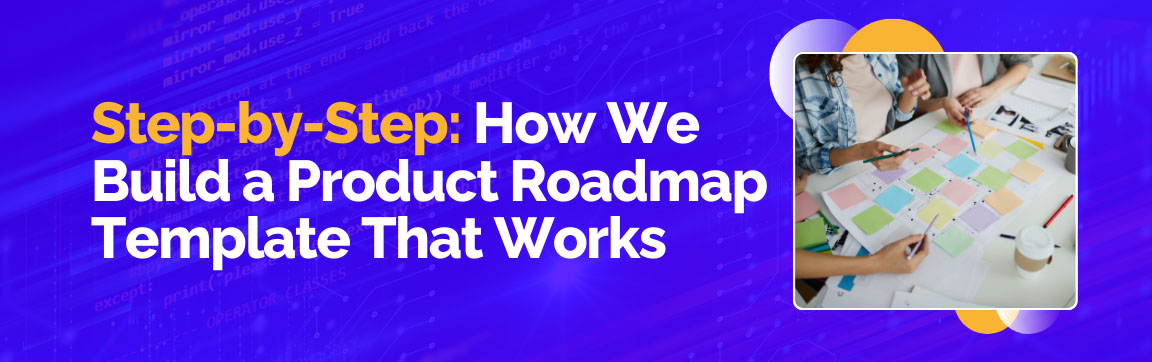
Step-by-Step: How We Build a Product Roadmap Template That Works
Step 1: Start with Strategy, Not Requests
We anchor roadmaps in business and customer goals—not stakeholder wish lists.
Step 2: Translate Goals into Outcomes
Outcomes define why initiatives exist.
Step 3: Group Work into Themes
Themes reduce noise and support adaptability.
Step 4: Define Metrics Early
If success isn’t measurable, alignment breaks down later.
Step 5: Socialize Before Finalizing
A roadmap is a communication tool first.
Real-World Example: Product Roadmap Template in Practice
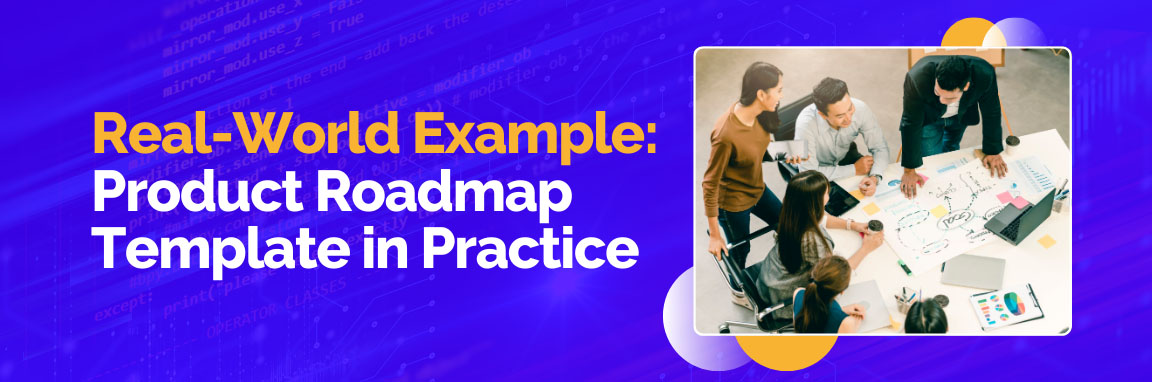
A B2B SaaS team struggling with roadmap churn redesigned their template around outcomes.
Before:
- Feature-heavy
- Quarterly rework
- Stakeholder frustration
After:
- Goal-driven roadmap
- Clear tradeoffs
- Improved delivery predictability
Within two quarters, roadmap confidence increased and planning cycles shortened.
Product Roadmap Templates for Different Audiences
Executive Roadmap Template
Focus: Strategy, risk, investment
Delivery Team Roadmap Template
Focus: Dependencies, sequencing, execution clarity
Customer-Facing Roadmap Template
Focus: Direction, value, transparency (without commitments)
How Product Roadmaps Support AI-Driven Products

In AI-driven products, roadmaps must explicitly include:
- Experimentation cycles
- Model iteration phases
- Data readiness milestones
- Governance checkpoints
Traditional templates often miss this.
Common Mistakes to Avoid
- Treating the roadmap as a contract
- Updating it only quarterly
- Hiding uncertainty
- Confusing activity with impact
Best Practices for Using Product Roadmap Templates at Scale
- Review monthly, not quarterly
- Tie roadmap updates to metrics
- Keep one source of truth
- Train stakeholders on how to read the roadmap
FAQs: Product Roadmap Template
What is a product roadmap template?
A structured framework used to plan and communicate product strategy over time.
How detailed should a product roadmap be?
High-level enough to remain flexible, detailed enough to guide decisions.
Should roadmaps include dates?
Only when necessary. Time horizons often work better.
How often should a roadmap be updated?
Continuously, with formal reviews at least monthly.
Can one template work for all teams?
Rarely. Templates should be adapted to context.
Conclusion: How We Use Product Roadmap Templates to Drive Real Strategy
We believe a product roadmap template is not a document you fill out—it is a thinking tool. In 2026, the teams that succeed are not the ones with the most detailed roadmaps, but the ones with the clearest strategic intent behind them.
A strong product roadmap template helps us move conversations away from individual features and toward outcomes, tradeoffs, and long-term direction. It creates a shared language between product, engineering, design, and leadership. More importantly, it provides a structured way to make decisions in environments where uncertainty is the norm, not the exception.
From our experience, the most effective roadmaps are flexible by design. They acknowledge what is known, make assumptions explicit, and leave room for learning. They are reviewed often, challenged openly, and updated as reality changes. When used this way, a roadmap stops being a static plan and becomes an active guide for execution.
We also see roadmaps as a trust mechanism. When stakeholders understand why priorities exist—and what tradeoffs were made—they are far more aligned, even when plans evolve. This is especially critical as products become more complex, AI-driven, and deeply connected to business strategy.
This is the approach we take when helping teams design and operationalize product roadmaps at Trantor Inc. We focus on clarity over certainty, outcomes over outputs, and systems that scale with both the product and the organization.
A product roadmap is not a promise of dates or features.
It is a shared understanding of direction.
And with the right product roadmap template, that understanding becomes one of the most powerful assets a product team can have.