Software Development, zBlog
20 Software Development Methodologies Explained
Team Trantor | Updated: July 17, 2026

Software development methodologies are the frameworks that govern how your team plans, builds, and ships software. Choosing the right one is not an academic exercise. According to the Digital.ai State of Agile Report, Agile software development methodologies fail at a 9 percent rate, compared to 29 percent for Waterfall, more than three times higher. Teams using no formal methodology at all fail at over 40 percent. The methodology your team chooses shapes every decision that follows: how you plan work, how you respond to change, how you measure progress, and how fast you can ship.
In 2026, the software development methodology landscape offers more options than at any point in its history, and the introduction of AI into the development process is actively changing how each is practiced. Agile sprints now incorporate AI for velocity prediction and automated story generation. Kanban boards use AI to identify WIP bottlenecks in real time. Continuous delivery pipelines run AI-generated test suites, reducing the QA stage by up to 40 percent. The methodology question is no longer just about process. It is about which process integrates most naturally with the AI-augmented development workflow that is becoming standard in 2026.
This guide covers every major software development methodology in enough depth to be genuinely useful, with failure-rate data, adoption statistics, and real-world use cases that most methodology overviews omit. It also covers the decision framework that determines which software development methodology fits which team, and why the answer is never simply “just use Agile.”
The question of software development methodology matters more than most teams think. A study from the Standish Group found that project size, complexity, and the rigor with which a methodology is followed are stronger predictors of success than the specific methodology chosen. The best software development methodology is the one your team will genuinely apply with discipline, not the one that sounds best in a proposal.
Why Software Development Methodology Choice Actually Matters
Before comparing software development methodologies, it is worth spending a moment on why the choice matters as much as the data suggest. The failure rate gap between Agile (9 percent) and Waterfall (29 percent) is not driven by the names or the vocabulary. It reflects a structural difference in how the two approaches handle two things that are true of almost every software project: requirements that change, and information that is only available once building has started.

The waterfall software development methodology locks requirements at the start, builds the system sequentially, and delivers at the end. This works when requirements genuinely are stable and complete up front, which is uncommon in software development but common in construction and manufacturing, the domains from which Waterfall was originally adapted. When requirements change after the planning phase in a Waterfall project, the cost of incorporating that change is high because it often requires backing up to an earlier phase, which is expensive and sometimes politically impossible.
Agile software development methodologies assume that requirements will evolve, that development occurs in short cycles, and that each cycle is an opportunity to incorporate new information. The 9 percent failure rate for properly implemented Agile reflects this structural advantage: problems are discovered early and cheaply rather than late and expensively. The 55 percent failure rate for poorly implemented Agile, where stand-ups become status meetings, retrospectives are skipped, and sprints become mini-Waterfalls, reflects that the methodology’s name is not the same as the methodology’s discipline.
The Major Software Development Methodologies Explained
Software Development Methodologies Compared : Agile vs Waterfall vs Kanban vs SAFe
| Agile/Scrum | Waterfall | Kanban | SAFe | |
|---|---|---|---|---|
| Best for | Evolving requirements, product teams | Fixed scope, regulatory, construction analogies | Visualization, flow optimization | Large enterprise, multi-team scaling |
| Timeline | 2-4 week sprints | Linear phases, months to years | Continuous flow, no fixed sprints | PI Planning, 8-12 week PIs |
| Team size | 5-11 people | Any, often large | 3-10 per board | 50-1000+ people |
| Change tolerance | High, welcome it | Low, expensive to change | Medium, pull system | Medium, within PI |
| Failure rate | 9% | 29% | Not tracked independently | Lower than Waterfall |
| 2026 AI fit | Strong, AI in sprints | Weak, too rigid | Strong, AI kanban tools | Moderate, complex |
| Agile/Scrum | |
|---|---|
| Best for | Evolving requirements, product teams |
| Timeline | 2-4 week sprints |
| Team size | 5-11 people |
| Change tolerance | High, welcome it |
| Failure rate | 9% |
| 2026 AI fit | Strong, AI in sprints |
| Waterfall | |
|---|---|
| Best for | Fixed scope, regulatory, construction analogies |
| Timeline | Linear phases, months to years |
| Team size | Any, often large |
| Change tolerance | Low, expensive to change |
| Failure rate | 29% |
| 2026 AI fit | Weak, too rigid |
| Kanban | |
|---|---|
| Best for | Visualization, flow optimization |
| Timeline | Continuous flow, no fixed sprints |
| Team size | 3-10 per board |
| Change tolerance | Medium, pull system |
| Failure rate | Not tracked independently |
| 2026 AI fit | Strong, AI kanban tools |
| SAFe | |
|---|---|
| Best for | Large enterprise, multi-team scaling |
| Timeline | PI Planning, 8-12 week PIs |
| Team size | 50-1000+ people |
| Change tolerance | Medium, within PI |
| Failure rate | Lower than Waterfall |
| 2026 AI fit | Moderate, complex |
Which Software Development Methodology Should Your Team Use?
The decision framework below applies across team sizes, industries, and project types. No single software development methodology is correct in all contexts.

Choose Agile or Scrum when: your requirements will evolve as you learn more, you have direct access to customers or stakeholders who can provide feedback on working software, your team can commit to sprint boundaries without them being constantly interrupted by urgent “priority” work, and your organization supports the Product Owner role with real authority to make scope decisions.
Choose Waterfall when: the full scope genuinely is defined and stable before development begins, you are building to a fixed contract with a defined deliverable and fixed price, your regulatory environment requires phase-gate approvals before moving to the next phase, or you are integrating software development into a physical manufacturing or construction process that cannot iterate.
Choose Kanban when your team handles work that arrives continuously and unpredictably; you are running a support or operations function rather than building a new product; your work items are not naturally groupable into sprint-sized batches; or you want a lighter-weight approach than Scrum for a small team.
Choose SAFe when you have multiple Agile teams building interdependent components of a larger system, coordination between teams is a significant source of delay, and you need a shared planning cadence across the whole organization to keep teams aligned without creating a centralized bottleneck.
Choose Shape Up when: you have a small, experienced team; you trust the team to find the right solution within a fixed time budget; you want to eliminate backlog grooming and estimation overhead that consumes significant time in Scrum; and your product direction is internally driven rather than externally specified.
HONEST CAVEAT: Most large organizations end up using a hybrid of software development methodologies rather than a single pure approach. Product teams may run Scrum, infrastructure teams may run Kanban, enterprise programs may coordinate using SAFe, and new product explorations may use Shape Up cycles. The right approach is the one that fits the specific type of work, team structure, and customer relationship for each context.
Agile Software Development Adoption by Industry in 2026
Agile software development methodologies have become dominant across most industries, but adoption rates and implementation maturity vary significantly by sector.
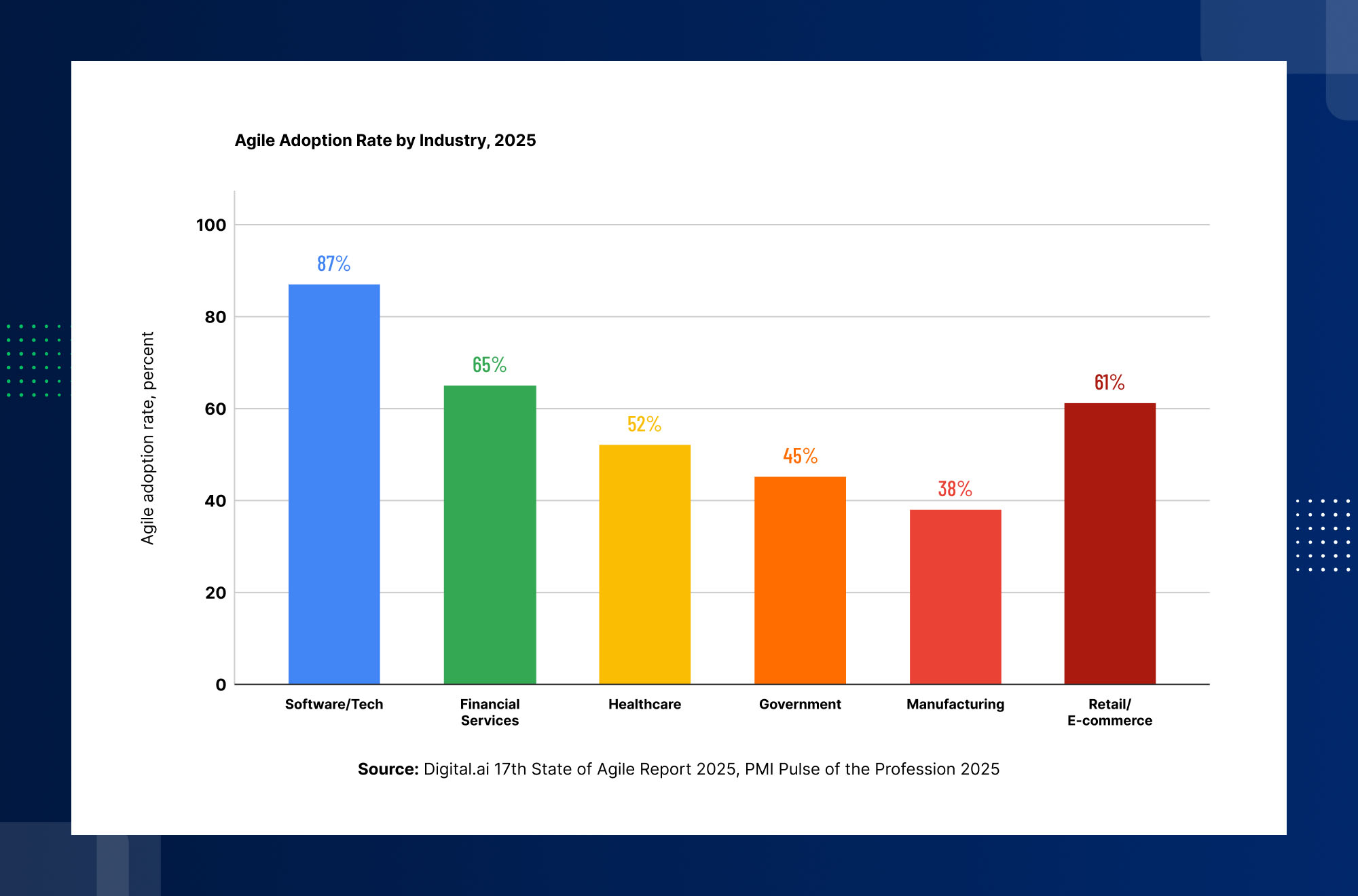
Software and technology organizations lead at 87 percent Agile adoption, reflecting the sector where Agile software development methodologies were originally developed. Financial services has reached 65 percent, driven by the pace of digital transformation and competition from fintech companies that ship faster using Agile. Healthcare sits at 52 percent, constrained by regulatory requirements that slow the adoption of fully iterative development but increasingly using Agile for digital product development alongside Waterfall-style compliance documentation.
Government at 45 percent and manufacturing at 38 percent reflect sectors where procurement and compliance requirements still push toward sequential, documented methodologies even as the underlying technology work would benefit from iteration. Retail and e-commerce have reached 61 percent, driven by rapid digital channel development and competitive pressure to ship features faster than competitors.
How AI Is Changing Software Development Methodologies in 2026
The most significant development in software development methodologies in 2026 is not a new methodology. It is the integration of AI tools into every existing methodology in ways that change how specific practices work.

AI in Agile sprint planning: AI tools can analyze historical sprint data to predict which story point estimates are likely to be accurate versus underestimated, surface dependencies between backlog items that human planners miss, and generate draft acceptance criteria from rough user story descriptions. Teams using AI-assisted sprint planning report more accurate velocity predictions and fewer sprint goal failures caused by missed dependencies.
AI in continuous delivery pipelines: The most mature AI integration in software development methodologies is in testing. AI-generated test suites that expand test coverage beyond what human QA engineers would manually write, combined with AI-powered code review that flags common vulnerability patterns, are shortening the QA phase of continuous delivery cycles by up to 40 percent in organizations that have integrated these tools. This directly accelerates Agile and Kanban delivery cadences without changing the underlying methodology.
AI in code review and Kanban flow: AI code review tools that flag issues before a pull request enters the review column of a Kanban board reduce the time items spend waiting for human review, improving the throughput metric that Kanban optimizes for. Several teams have implemented AI pre-review as an additional Kanban column that provides automated feedback before items queue for human review.
AI and Waterfall documentation: Even Waterfall software development methodology benefits from AI in the documentation-heavy early phases. AI tools can generate first-draft requirements, functional, and design documents from structured inputs, accelerating the phase-gate deliverables that Waterfall depends on without changing the sequential structure.
The honest limitation: AI tools in 2026 augment software development methodologies rather than replace the judgment calls they require. AI cannot tell you whether a sprint goal is the right one, whether a Kanban WIP limit is set correctly for your team’s context, or whether a PI Planning outcome actually aligns with the business strategy. The human judgment that methodologies are designed to structure remains essential.
Common Mistakes When Implementing Software Development Methodologies
Agile in name only: Running daily standups and calling work sprints without protecting sprint boundaries, enforcing the Product Owner role, or actually delivering working software at the end of each sprint. This produces the 55 percent failure rate for poorly implemented Agile rather than the 9 percent for properly implemented Agile.
Choosing Waterfall because it feels safer: Project managers sometimes opt for Waterfall because its sequential phases and formal sign-offs seem like risk management. For most software projects, this is false security. Requirements written at the start of a project are consistently less accurate than requirements written after users have seen working software.
Treating SAFe as a magic coordination solution: Adopting SAFe vocabulary and PI Planning ceremonies without actually reorganizing teams, budgets, and leadership accountability to support Agile at scale. SAFe requires organizational change that goes well beyond process training.
Skipping retrospectives: The retrospective is the mechanism through which every software development methodology that includes one actually improves over time. Teams that skip retrospectives under deadline pressure are specifically skipping the practice most responsible for preventing the same mistakes in the next cycle. PMI research found that only 25 percent of teams run retrospectives consistently.
METHODOLOGY ADOPTION FAILURE: The most common reason software development methodology adoption fails is not choosing the wrong methodology. It is choosing a methodology without changing the organizational conditions that would make it work. Scrum requires a Product Owner with real authority to make scope decisions. Kanban requires WIP limits that are actually enforced. SAFe requires leadership commitment to PI Planning that takes precedence over other scheduling conflicts. Methodology names without those organizational changes are labels, not practice.
Frequently Asked Questions About Software Development Methodologies
Choosing the Right Software Development Methodology Matters More Than Most Teams Think
Software development methodologies are not interchangeable labels for “how we plan work.” They encode fundamentally different assumptions about how software projects work, how requirements evolve, and what the relationship between a development team and its stakeholders should look like. The 9 percent versus 29 percent failure rate gap between properly implemented Agile and Waterfall is not a coincidence. It reflects a structural advantage for iterative methods in the environment where most software development actually happens: uncertain requirements, changing priorities, and users who only know what they want after they have seen something.
The most important question is not which software development methodology has the highest aggregate success rate. It is which methodology fits the specific context of your team, your project type, your client relationship, and your organizational culture. Getting that match right is one of the highest-leverage decisions a technical leader makes, because it shapes every subsequent project planning, delivery, and communication decision.
At Trantor, we adapt software development methodologies to fit the actual needs of each engagement rather than imposing a single framework on every project. We have delivered software using Agile, Scrum, Kanban, SAFe, and hybrid approaches, and we bring the experience to recommend and implement the right software development methodology for your specific context, team size, and delivery requirements. If you are choosing a methodology for a new initiative or trying to improve delivery on an existing one, we are ready to help.
Explore Trantor’s Software Development Services: Software Development