Artificial Intelligence, zBlog
Agentic AI in HR: The Future of Recruiting, Onboarding, and Employee Support
Team Trantor | Updated: May 8, 2026
HR has always been where organizations make their most consequential people decisions — who gets hired, how they get integrated, and whether they stay long enough to deliver value. For decades, those decisions have been supported by paperwork, spreadsheets, manual scheduling, and the heroic individual effort of HR professionals who spend the majority of their workday on administrative tasks rather than the strategic people work that actually moves the needle.
That structural tension is now breaking open. Agentic AI — autonomous AI agents capable of executing multi-step workflows, connecting to enterprise systems, and acting without a human prompt at every step — is doing for HR what cloud computing did for IT: replacing the manual coordination overhead with intelligent infrastructure that scales, operates around the clock, and gets measurably better over time.
The data signals how fast this shift is moving. A May 2025 Gartner survey found that 82% of HR leaders plan to implement some form of agentic AI within the next 12 months. AI use across HR tasks climbed to 43% in 2026, up from just 26% in 2024. PwC’s Global AI Jobs Barometer found AI is linked to a fourfold increase in productivity growth in industries most exposed to it. And Gartner’s long-range forecast places the destination clearly: by 2030, 50% of current HR activities will be AI-automated or performed by AI agents.
This is not incremental improvement. It is a structural redesign of how HR operates — from a department that reacts to workforce events to one that anticipates and acts on them before they become problems.
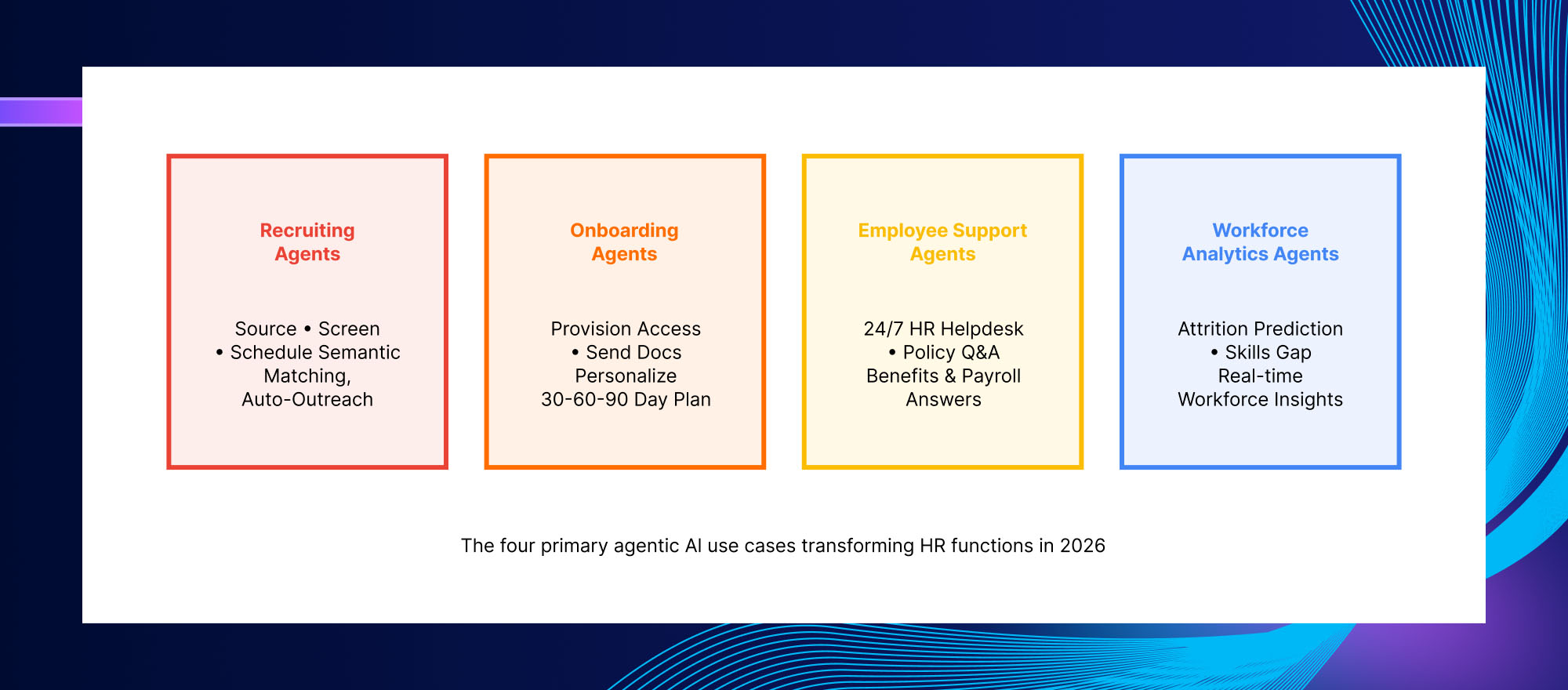
The Four Primary Agentic AI Use Cases in HR
What Agentic AI Actually Changes in HR — And Why It Is Different This Time
Every technology wave has promised to transform HR. Most delivered incremental productivity improvements — digital forms replacing paper, ATS platforms replacing spreadsheets, analytics dashboards replacing manual reporting. Each step reduced friction. None fundamentally changed what HR professionals spend their time doing.
Agentic AI is architecturally different. Earlier AI tools were reactive: they would screen a resume when asked, or rank candidates when prompted. An agentic HR system is proactive. It monitors workforce signals — a decline in engagement scores, a stalled recruitment pipeline, an anomaly in payroll data, a new hire approaching the 90-day attrition risk window — and takes autonomous action to address them across systems like Workday, ServiceNow, Greenhouse, and Slack.
A Stanford University 2025 study on the Future of Work with AI Agents (Shao et al.) found that AI agents are absorbing routine “information-processing” tasks so that human value shifts toward interpersonal and organizational skills. As agents handle orchestration, HR professionals move to high-agency work: culture building, conflict resolution, strategic workforce planning, and the judgment calls that no autonomous system should make unilaterally.
The distinction ADP’s Chief Data Officer captures it directly: “Agentic AI unlocks new frontiers of automation, coordinating multi-step work and adapting to real-world variability. Human oversight provides purpose and guardrails, thereby clarifying objectives, approving critical actions and reviewing impacts. Together, they deliver scalable automation that’s trustworthy, compliant and resilient when conditions change.”
Agentic AI in Recruiting: From Reactive Screening to Proactive Talent Acquisition
Recruiting is where agentic AI has made the fastest, most measurable impact in HR — and where the transformation from reactive to proactive is most visible. Traditional talent acquisition followed a fundamentally reactive pattern: a requisition opens, recruiters source candidates, candidates apply, resumes get screened. The process was bottlenecked at every step by human availability and manual coordination.
How Recruiting AI Agents Work
Recruiting AI agents operate across the entire talent acquisition lifecycle without requiring a human prompt at each step. When a new requisition is approved in the ATS, the agent begins autonomously sourcing candidates across job boards, LinkedIn, talent databases, and internal mobility platforms simultaneously. Rather than keyword matching against job titles and degrees, modern recruiting agents use semantic search — evaluating actual skill clusters, career trajectories, and demonstrated competencies regardless of how a resume is formatted.
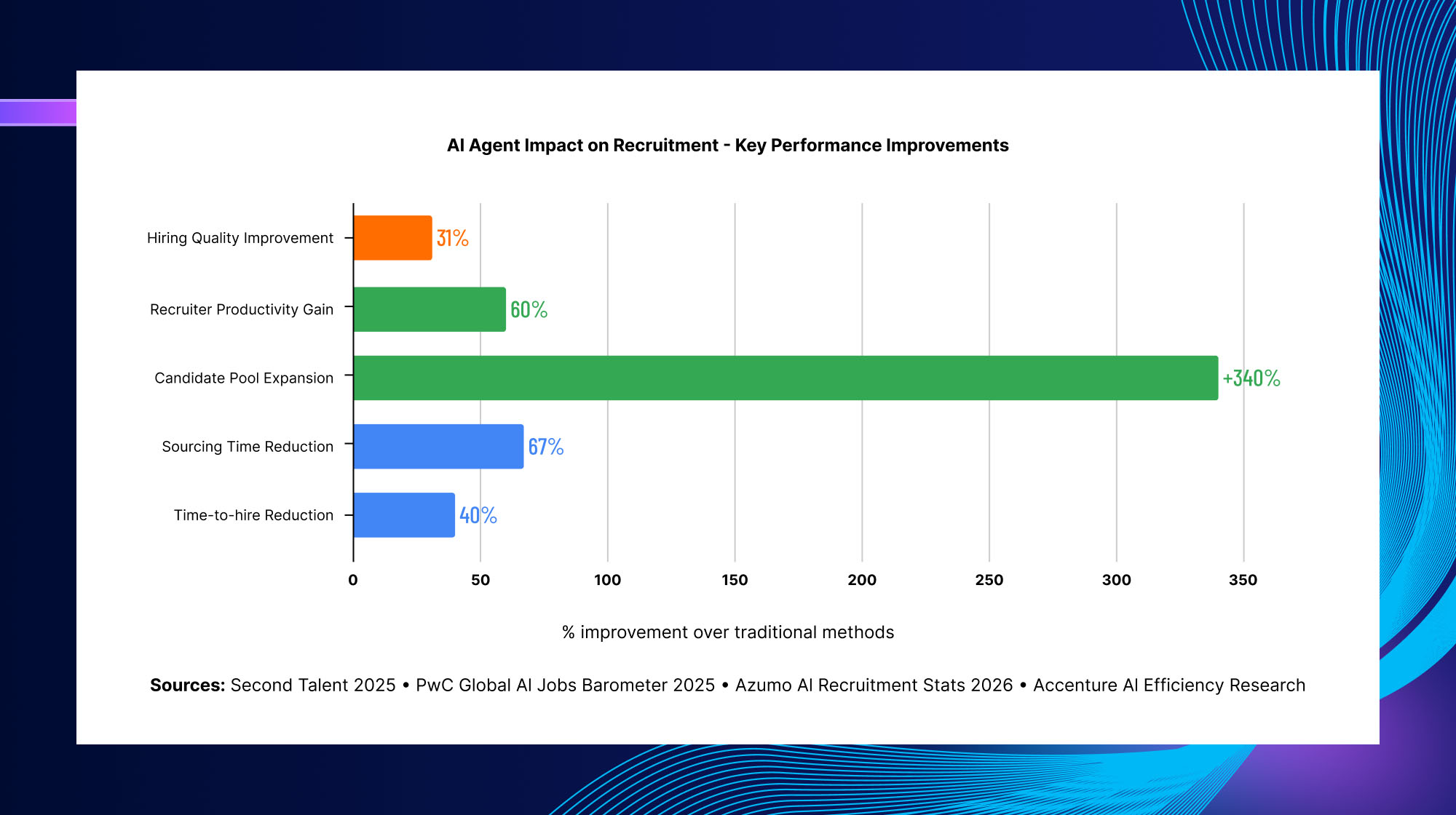
AI sourcing has expanded candidate pools by an average of 340% while reducing sourcing time by 67%, according to Second Talent’s 2025 research. Semantic search finds 60% more relevant profiles than traditional Boolean queries and reduces false-positive rates by 62%. Critically, 40% of viable mid- and junior-level candidates come from sources that traditional ATS keyword tools miss entirely.
Beyond sourcing, recruiting agents handle the coordination overhead that currently consumes 35% of all recruiter time — interview scheduling. By syncing with all parties’ calendars, handling time zones, sending reminders, and managing reschedules autonomously, AI scheduling tools compress what used to be a 3-4 day back-and-forth into minutes. In 2025, 41% of talent acquisition teams piloted AI scheduling tools, and those that fully deployed reported 60-80% reductions in coordination time.
AI Agent Impact on Recruitment — Key Performance Improvements
What the Numbers Show
Companies implementing agentic AI workflows in recruiting report 30-50% faster time-to-hire, with some high-volume teams seeing efficiency improvements of up to 70%. Paradox’s “Olivia” chatbot — deployed by FedEx and Unilever — handles over 100 simultaneous candidate conversations and completes screening workflows in under 48 hours that previously took 5-7 days.
AI-based skill matching now predicts job performance with 78% accuracy and retention likelihood with 83% accuracy, according to Second Talent’s 2025 research. Organizations using AI for recruiting see a 31% increase in quality of hire (Accenture AI Efficiency Research). Candidates selected by AI have an 18% higher chance of accepting a job offer when extended — a benefit driven in part by the faster, more personalized candidate experience that agentic systems deliver.
Recruiter productivity increases by 60% when AI handles administrative tasks. AI-powered chatbots handle 67% of initial candidate inquiries without human intervention, improving response times by 89%. And 45% of recruiters report that AI helps them manage a significantly larger number of candidates simultaneously, enabling talent programs that would be impossible with manual processes.
The Human Role in AI-Augmented Recruiting
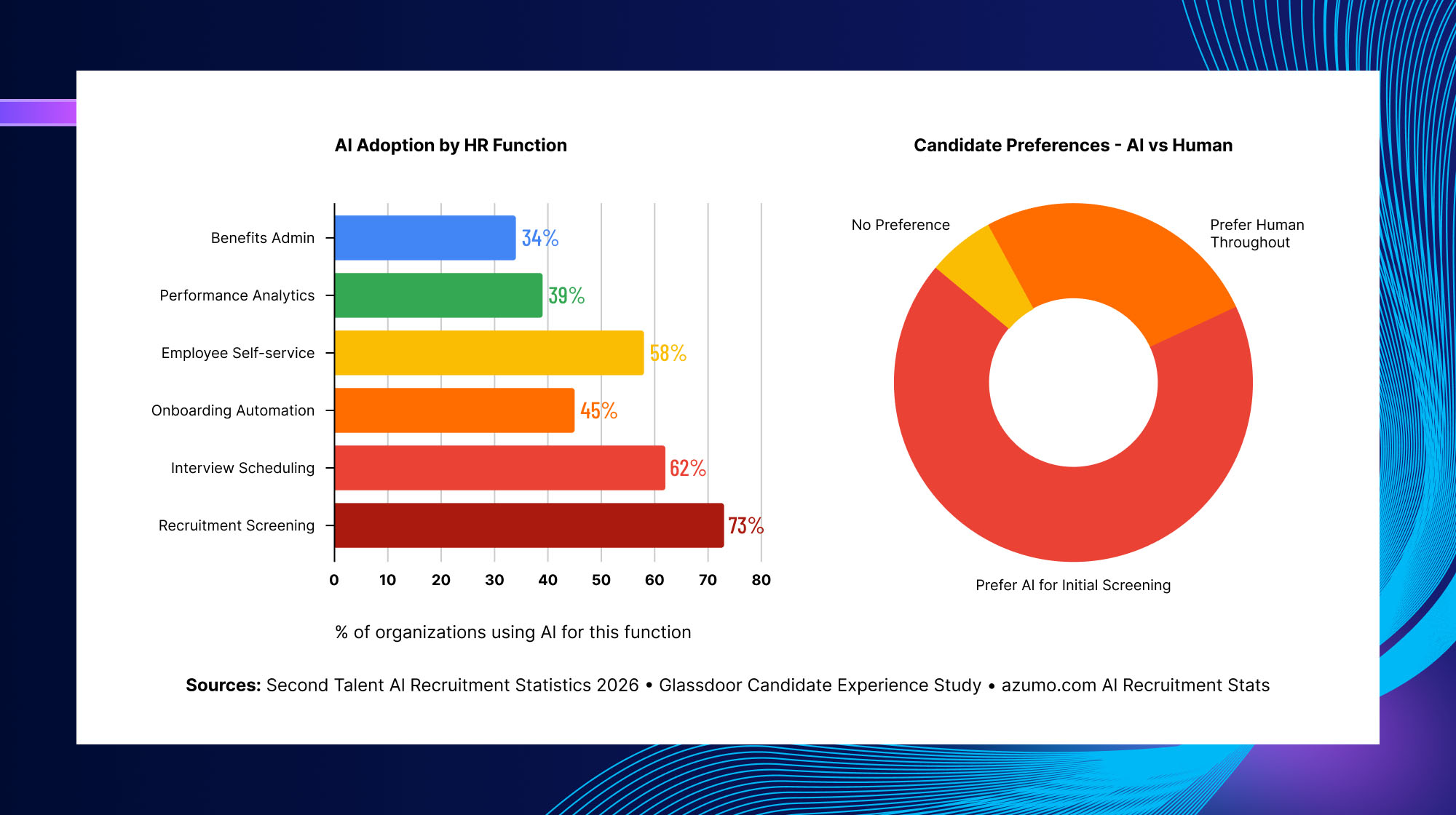
The numbers on candidate preferences matter here: 68% of candidates prefer AI-enhanced processes for initial screenings, but 74% want human interaction for final decisions (Glassdoor Candidate Experience Study). This preference maps directly to the appropriate governance model: AI agents handle the volume work of sourcing, screening, scheduling, and coordination; human recruiters make the final hiring calls, build the candidate relationships that determine offer acceptance, and exercise the judgment that identifies non-obvious talent who would not surface through any algorithmic ranking.
In 2025, 93% of hiring managers still said human involvement is essential even as AI usage grows. The consensus in 2026 is clear: the best outcomes come from human-AI collaboration, not AI autonomy. Recruiters who thrive are those who can interpret AI insights, identify when AI recommendations need to be overridden, and apply emotional intelligence to candidate interactions that AI cannot replicate.
One regulatory note that every talent acquisition leader must understand: as of 2026, many jurisdictions restrict or outright ban AI analysis of facial expressions and emotional states. The EU AI Act’s Chapter II explicitly prohibits emotion recognition in workplace contexts from February 2025. Any vendor marketing facial micro-expression analysis in hiring is operating in legally precarious territory.
Agentic AI in Onboarding: Closing the Gap Between Hiring and Productivity
If recruiting is where organizations win talent, onboarding is where they keep it — or lose it. The statistics on traditional onboarding are damning. Only 12% of employees strongly agree their company does a great job onboarding new hires. Eighty percent of new hires who feel undertrained because of poor onboarding plan to quit soon. The average cost of a failed new hire is estimated at $25,000-$50,000 by HR Directors and CHROs, including recruiting, training, productivity losses, and team disruption.
The structural problem: traditional onboarding is a multi-system, multi-team coordination challenge that currently relies on manual handoffs across HR, IT, Finance, Legal, and the hiring manager’s team. Every handoff is a potential gap where access gets missed, paperwork is delayed, training is skipped, and the new hire’s first-week experience becomes one of confusion rather than welcome.
How Onboarding AI Agents Work
An onboarding AI agent recognizes the trigger: an offer is signed in the ATS. From that moment, it orchestrates the entire onboarding process across every system involved — without a human needing to chase each step manually. It provisions software licenses via IT’s ticketing system, sets up payroll profiles in Finance, schedules compliance training through the LMS, sends pre-boarding welcome materials, creates calendar holds for the manager’s first-week check-ins, and messages the hiring manager in Slack with a 30-60-90 day integration plan.
The personalization capability is what separates agentic onboarding from simple workflow automation. The agent adapts the onboarding journey to the new hire’s specific role, experience level, location, and the team they are joining. A senior engineer joining a distributed product team gets a different onboarding sequence than a junior sales representative joining a co-located commercial team — not because someone manually configured that difference, but because the agent reasons about the relevant variables and constructs the appropriate plan.
AI-Powered Onboarding — Measured Outcomes
The Measurable Impact of AI-Powered Onboarding
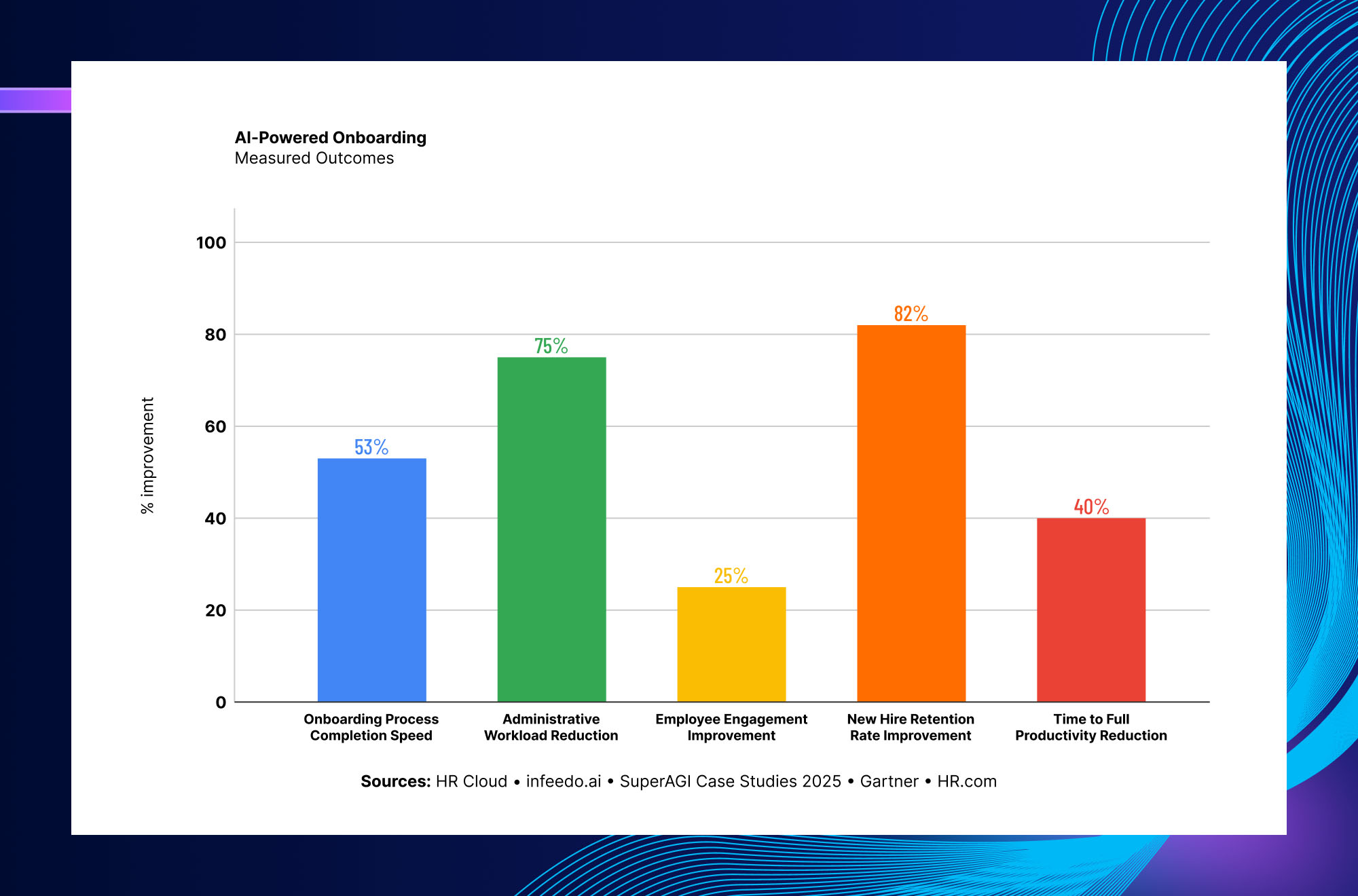
Organizations implementing AI solutions in onboarding report 53% faster onboarding process completion, a 75% reduction in administrative workload for HR teams, and a 73% reduction in errors in employee data collection. AI onboarding solutions save organizations over $18,000 annually on average through automated administrative tasks alone.
The retention impact is the most significant number in this space: organizations with robust AI onboarding programs see an 82% improvement in new hire retention rates within the first year. At an average cost of $25,000-$50,000 per failed new hire, every percentage point improvement in 90-day retention has direct, quantifiable financial value. AI-powered onboarding can also reduce the time for employees to reach peak performance by 40% — which, for knowledge workers, represents weeks of productive output recovered.
Gartner’s October 2025 CHRO survey identified harnessing AI to revolutionize HR as the top priority for 2026. The survey’s onboarding-specific finding: 40% of enterprise applications will use task-specific AI agents to orchestrate work across systems by end of 2026, fundamentally changing how onboarding software operates.
One practical example from the valuex2.com 2026 agentic HR systems guide: “A single Onboarding Agent recognises when an offer is signed in the ATS, provisions software licences via IT’s ticketing system, sets up payroll profiles in Finance, and messages the new hire’s manager in Slack with a 30-day integration plan. In practice, this reduces manual handoffs and prevents ‘day one’ surprises such as missing access or incomplete paperwork.”
Preboarding: The Window That Organizations Consistently Miss
The onboarding transformation begins before the first day. The period between offer acceptance and start date — preboarding — is when new hire commitment is most fragile and organizational action is most impactful. Organizations that formalize preboarding through agentic automation consistently see stronger early commitment and lower drop-off risk.
A preboarding AI agent sends personalized welcome communications, delivers role-specific preparation materials, handles paperwork and compliance documentation before day one, connects new hires with their future teammates through structured introductions, and completes all system provisioning so the new hire arrives ready to work rather than waiting for access. The 52% of employees who report administrative tasks dominating their onboarding experience are telling HR that the work that should happen before they arrive is happening after — a gap that agentic preboarding directly addresses.
Agentic AI in Employee Support: The 24/7 HR Helpdesk That Never Burns Out
Employee support is the HR function where the math is most brutal. The average knowledge worker spends nearly 4.1 hours per week navigating fragmented support systems, according to HR.com’s 2025 survey. HR teams answer the same policy questions hundreds of times per year. Benefits enrollment produces a predictable flood of repetitive queries that peaks twice annually and overwhelms HR capacity. New hires have dozens of questions in their first weeks that they are often reluctant to ask because they do not want to appear uninformed.
The traditional HR helpdesk model — a mix of email threads, ticketing systems, shared mailboxes, and ad hoc Slack messages — creates exactly the fragmented experience that employees find frustrating and HR teams find exhausting. The problem is not that HR professionals are not working hard enough. It is that the system they are working within was not designed for the scale and speed that modern employees expect.
How Employee Support AI Agents Work
An employee support AI agent is the always-available, never-frustrated HR team member that no organization has been able to hire. Connected to the HRIS, benefits platforms, payroll systems, policy documentation, and internal knowledge bases, the agent answers policy questions, walks employees through benefits enrollment, checks PTO balances, explains payroll discrepancies, guides new hires through onboarding checklists, and escalates complex or sensitive situations to a human HR professional with full context already assembled.
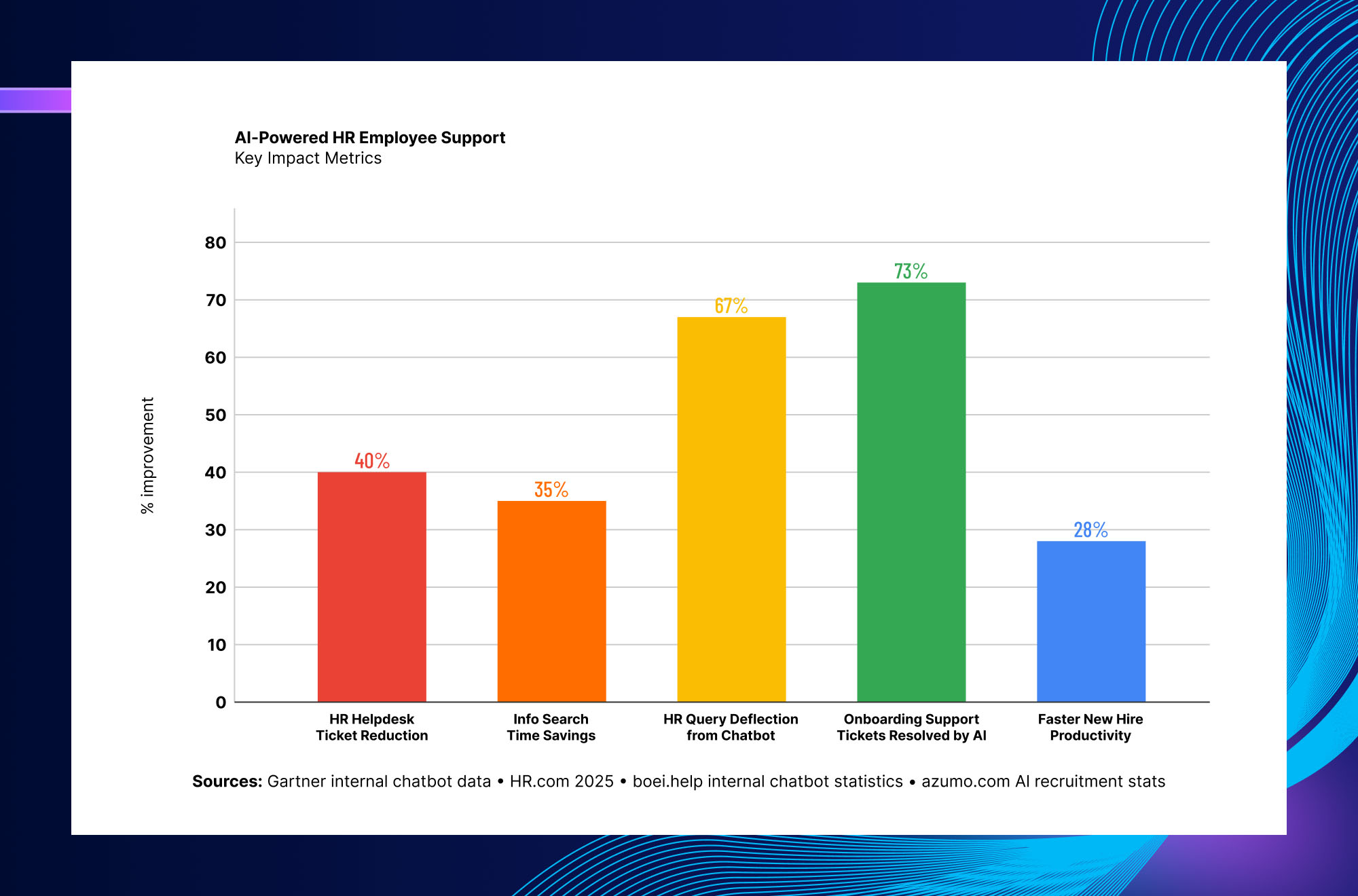
Gartner data shows a 40% reduction in IT and HR helpdesk tickets after implementing an internal AI chatbot. AI-powered chatbots handle 67% of initial employee inquiries without human intervention. For HR teams handling 500 tickets per month at an average resolution cost of $15 per ticket, a 40% reduction translates to $36,000 in direct annual savings — and that is before accounting for the HR professional time recaptured for higher-value work.
AI-Powered HR Employee Support — Key Impact Metrics
The 24/7 Advantage and the Psychological Safety Factor
The availability dimension of AI employee support deserves its own consideration. Employees often have sensitive questions — about parental leave, mental health resources, disciplinary procedures, or accommodation requests — that they hesitate to ask a human HR representative directly, particularly when the topic involves privacy or potential judgment. An AI support agent provides a judgment-free channel where employees can ask any question at any hour and receive accurate, consistent information.
This psychological safety dimension shows up in the data: organizations embedding AI support into their culture see 2.5x higher retention rates and 40% faster adaptation to change, according to Modern Health’s 2025 leadership report. The benefit is not just efficiency — it is the removal of the friction and anxiety that causes employees to avoid seeking the information and support they need to be productive and satisfied.
Integration: Where Agentic Support Beats Simple Chatbots
The distinction between a rules-based HR chatbot and a true agentic HR support system is the ability to take action rather than merely provide information. A rules-based chatbot can tell an employee what the PTO policy is. An agentic support system can check the employee’s current PTO balance across the HRIS, verify their team’s calendar for conflicts during their requested dates, submit the PTO request to their manager’s approval queue, send a confirmation to the employee, and update the team calendar — all from a single employee request, without a human touching any step.
This action-taking capability is what drives the ROI that organizations report. Companies using internal AI support chatbots see 25-30% faster new hire time to full productivity — because every day a new hire spends waiting for answers to basic operational questions is a day they are not yet fully contributing. For a knowledge worker role that typically takes three months to ramp up, a 25% improvement means productive work starts 2-3 weeks earlier.
Agentic AI in Workforce Analytics: From Reporting to Prediction
The fourth dimension of agentic AI’s impact on HR moves beyond specific functional workflows into the strategic intelligence layer that underpins all people decisions. Traditional HR analytics was retrospective — reports on what happened in the last quarter, dashboards showing current headcount and attrition rates, spreadsheets tracking training completion. Useful, but always looking backward.
Agentic workforce analytics operates prospectively. AI agents continuously ingest signals from across the organizational ecosystem — engagement survey responses, performance data, collaboration patterns, compensation benchmarking, internal mobility activity, learning platform usage — and surface actionable insights before the underlying trends become crises.
Attrition Prediction and Talent Risk Management
The capability that typically generates the fastest demonstrated ROI in workforce analytics is attrition prediction. AI agents analyze dozens of behavioral and organizational signals — declining engagement scores, changes in collaboration patterns, tenure milestones, compensation position relative to market, manager changes, internal posting views — and identify employees with elevated attrition risk months before they reach the decision to leave.
Advanced analytics predict job performance with 78% accuracy and retention likelihood with 83% accuracy, according to Second Talent’s 2025 data. AI can forecast skills gaps three years in advance, and 80% of organizations are expected to adopt this capability. The intervention window this creates — identifying a high-value employee at risk of departure weeks before they engage with external opportunities — is precisely the window where targeted retention actions (compensation adjustments, role evolution, development opportunities, manager conversations) have the highest probability of success.
Skills Intelligence and Internal Mobility
As labor markets tighten and skills requirements evolve faster than traditional hiring cycles can accommodate, organizations are increasingly turning to agentic AI to map their internal skills landscape and surface internal mobility opportunities that would otherwise be invisible. A skills intelligence agent continuously builds and updates a profile of every employee’s demonstrated capabilities, learning trajectory, and growth interests — and proactively surfaces internal opportunities that match, both to the employee and to the hiring manager who might not know the internal candidate exists.
By 2028, Gartner predicts 30% of recruitment teams will rely on AI agents for high-volume hiring and early-stage recruitment tasks — and a significant portion of that recruitment will increasingly be internal mobility facilitated by AI skills matching. Organizations with sophisticated internal mobility programs consistently outperform on both retention and time-to-productivity for new role placements, because the internal candidate already understands the culture, the systems, and the institutional context.
The HR AI Adoption Landscape — Who Is Ahead and Where the Gaps Are
AI Adoption by HR Function & Candidate Preferences
AI Adoption in HR — Growth Trajectory (2022–2027)
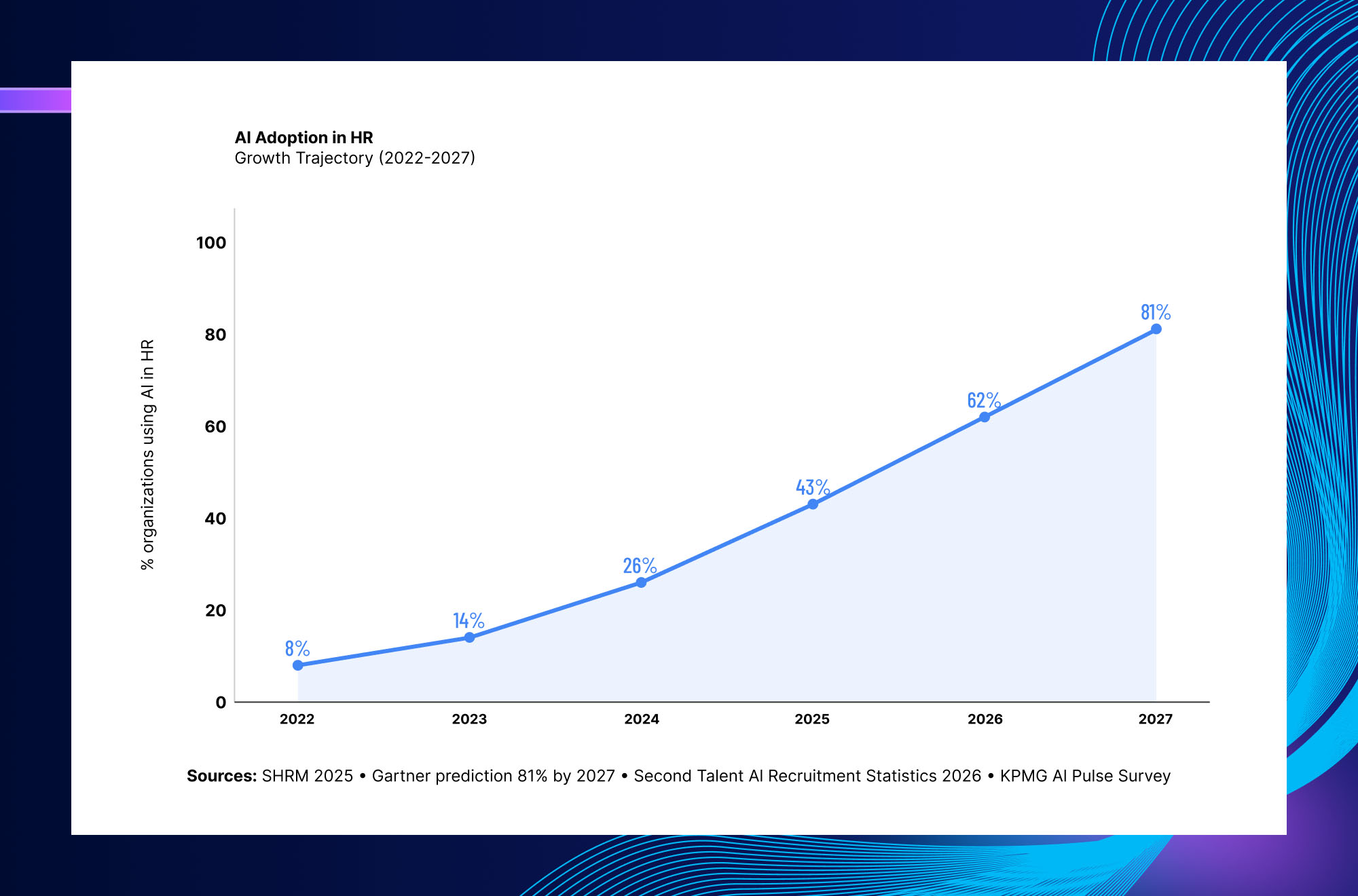
Industry adoption varies significantly. Technology companies lead with 89% AI adoption in HR, followed by financial services at 76% and healthcare at 62%, according to Gartner’s recruitment technology research. Gartner predicts AI adoption in recruitment will reach 81% by 2027, driven by competitive pressure and measurable ROI.
The gap between adoption intent and production deployment remains wide. KPMG’s Q4 2025 AI Pulse Survey found that AI agent deployment had nearly quadrupled, with 42% of organizations having deployed at least some agents, up from just 11% two quarters earlier. But most of these implementations are not highly autonomous systems — 85% of business processes over the next 12 months are still expected to operate at low autonomy levels, with high human involvement.
Trust is the central tension. Trust in fully autonomous AI agents has fallen from 43% of executives expressing confidence in 2024 to just 27% in 2025, according to Elevatus’s analysis. This decline reflects a market moving past initial enthusiasm into the sobering realities of implementation. The organizations seeing the best outcomes are those that have built trust incrementally — starting with read-only, recommendation-based AI and progressively expanding autonomy as performance evidence accumulates.
Governance, Bias, and the Human Oversight Imperative in HR AI
No domain in enterprise AI carries more consequence for individual people than HR. Hiring decisions determine who gets economic opportunity. Onboarding quality determines who stays and builds a career. Performance analytics determine who advances. Getting these decisions wrong — or allowing AI systems to automate them without appropriate human oversight — is not just an operational risk. It is an ethical and legal liability.
Bias Mitigation Is Non-Negotiable
AI systems trained on historical HR data will reproduce historical patterns — including historical biases. An AI recruiting agent trained on data from an organization that historically under-hired women in technical roles will, without active intervention, continue to under-surface women in technical roles. This is not a theoretical risk: it is a documented pattern that has resulted in regulatory investigations and public reputational damage for organizations that deployed AI recruiting tools without adequate bias monitoring.
The governance requirements for HR AI are specific: regular bias audits across protected characteristics (gender, race, age, disability status), explainability requirements for any AI-influenced hiring or compensation decision, human review for any decision with a disparate impact signal, and documentation of the basis for all AI-assisted decisions that affect employment.
The Legal Landscape Is Tightening
The regulatory environment for AI in HR is evolving rapidly and in the direction of greater accountability. The EU AI Act classifies employment-related AI systems as high-risk, requiring conformity assessments, human oversight mechanisms, and audit trails. In the United States, several states — including Illinois, Maryland, and New York City — have enacted AI in employment laws requiring disclosure, bias audits, and in some cases candidate consent. The EEOC has stated that organizations remain liable for AI-assisted hiring decisions regardless of which vendor’s technology is used.
Organizations deploying agentic AI in HR must maintain complete audit trails for every AI-influenced employment decision, have human review processes in place for decisions with material impact on individuals, conduct regular third-party bias audits, and ensure candidates and employees are appropriately informed about AI’s role in processes that affect them.
Building the Right Human-AI Partnership in HR
The most effective framework for governing HR AI is not to treat automation and human oversight as opposing forces, but to design the division of labor deliberately. HR professionals should make: all final hiring decisions, performance evaluations, disciplinary actions, compensation changes, and any decision with significant individual consequence. Agentic AI should handle: sourcing, initial screening, scheduling, documentation, routine query resolution, data analysis, and workflow coordination across systems.
Two-thirds of HR leaders who participated in Gartner’s May 2025 survey stated that they trusted AI agents would take actions that would benefit employee experience. Building and maintaining that trust requires transparency with employees about where and how AI is used, clear escalation pathways to human HR professionals, and a commitment to using AI to enhance the employee experience rather than to depersonalize it.
Implementation Roadmap: Building Your Agentic HR Program
Phase 1 — High-Volume Pilot (Weeks 1–8)
Start with one high-volume, logic-based HR workflow that already relies on digital systems and has clear, measurable outcomes. The most successful 2026 pilot areas are recruitment coordination (interview scheduling and initial candidate communications), Tier-1 employee support (benefits policy Q&A through an AI-powered helpdesk), and new hire document collection and system provisioning. Establish baseline metrics before deployment: time-to-respond, ticket volume, hours spent per process, and satisfaction scores.
Phase 2 — Onboarding Orchestration (Months 2–4)
Expand to full onboarding agent deployment. Connect the ATS, HRIS, IT ticketing system, LMS, and communication platforms through an orchestrated onboarding workflow. Implement personalized onboarding journeys based on role, level, and team. Build the preboarding sequence that begins at offer acceptance rather than start date. Set 90-day retention as your primary outcome metric.
Phase 3 — Integrated Employee Support (Months 4–6)
Deploy the AI employee support agent across the full HR policy landscape — benefits, payroll, PTO, compliance, and learning resources. Integrate with the systems the agent needs to take action, not just provide information. Build escalation protocols with full context handoff for sensitive or complex situations. Track deflection rate, resolution time, and employee satisfaction scores.
Phase 4 — Workforce Analytics and Predictive HR (Month 6+)
Activate the workforce intelligence layer: attrition prediction, skills gap analysis, internal mobility matching, and compensation benchmarking. Connect signals from engagement surveys, performance data, collaboration tools, and external labor market data. Build the dashboard and alerting infrastructure that surfaces actionable insights to HR business partners and people managers before trends become crises.
Frequently Asked Questions About Agentic AI in HR
Conclusion: The HR Function That Anticipates Rather Than Reacts
The organizations that will win the talent competition over the next decade are not necessarily those with the highest compensation packages or the most prestigious brands. They are the ones that can hire faster and more accurately, onboard more effectively, answer employee questions before they become frustrations, and identify people risks before they become turnover. Agentic AI is the infrastructure that makes that level of HR performance achievable at scale.
The numbers are clear. AI use across HR tasks doubled in a single year, from 26% to 43%. Eighty-two percent of HR leaders are planning agentic AI implementation within 12 months. Organizations deploying AI in recruiting are seeing 31% improvements in quality of hire and up to 70% reductions in sourcing time. Organizations with AI-powered onboarding are retaining 82% more new hires in the first year. And by 2030, Gartner projects half of all HR activities will be AI-automated or performed by AI agents.
The governance imperative is equally clear. AI in HR operates on the most consequential data organizations hold — the data that determines who gets opportunity, who advances, and who is recognized. Getting the oversight right is not a constraint on the technology’s value. It is the prerequisite for capturing that value sustainably and ethically.
At Trantor, we help enterprise HR and technology organizations build agentic HR programs that deliver measurable outcomes — faster hiring, stronger onboarding, more effective employee support, and the workforce intelligence infrastructure that turns HR from a reactive administrative function into a strategic business partner. We bring the architectural depth to design agentic HR systems that connect your HRIS, ATS, LMS, and communication platforms into a coherent intelligence and automation layer. We bring the governance expertise to ensure your AI HR program is bias-audited, compliance-ready, and trusted by the employees and candidates it serves. And we bring the practical deployment experience to get your program from pilot to production without the implementation challenges that derail most enterprise AI programs.
Whether you are designing your first agentic recruiting workflow, building an onboarding orchestration system that eliminates day-one friction, deploying the AI employee support platform that answers questions at 2am as reliably as at 2pm, or building the workforce analytics layer that predicts attrition before it happens — that is the conversation we are built for.
The future of HR is not just digital. It is agentic. Trantor helps you get there.