Artificial Intelligence, zBlog
Augmented Reality in Accounting: Boosting Accuracy, Efficiency, and Client Engagement
Team Trantor | Updated: December 3, 2025
Introduction: The Next Frontier in Financial Technology
Accounting is evolving faster than ever. From cloud-based ERPs to AI-driven analytics, each technological leap has helped firms gain new levels of accuracy and insight. Yet, one emerging technology is set to transform how accountants visualize, analyze, and present data — Augmented Reality In Accounting.
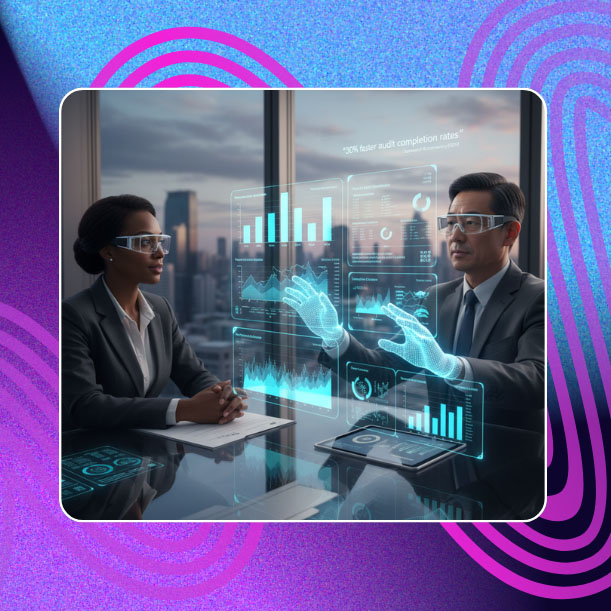
Augmented Reality in Accounting is not just a buzzword. It’s a practical innovation that overlays financial data, reports, and workflows with digital, interactive elements that help teams and clients interpret complex information visually. Whether used for audits, client presentations, or training, AR brings clarity, engagement, and precision to accounting processes.
According to PwC’s Tech at Work Survey (2025), over 47% of finance leaders in the U.S. believe AR and VR technologies will play a measurable role in audit and advisory services within the next five years. This surge reflects a growing demand for tools that combine transparency, automation, and visual storytelling in financial operations.
What Is Augmented Reality in Accounting?

Augmented Reality (AR) is a technology that superimposes digital information—such as visuals, data charts, or 3D models—onto the real world through devices like smartphones, tablets, or AR glasses. In accounting, this means overlaying financial insights and audit data onto physical documents, dashboards, or even client meeting spaces.
Imagine walking through a company’s warehouse while AR highlights assets, inventory values, and audit anomalies in real time. Or picture an accountant reviewing a balance sheet projected in 3D, where each metric can be expanded, rotated, and analyzed interactively. This is Augmented Reality in Accounting — a hybrid of financial analytics and immersive visualization.
Why Accounting Firms Are Turning to AR Solutions
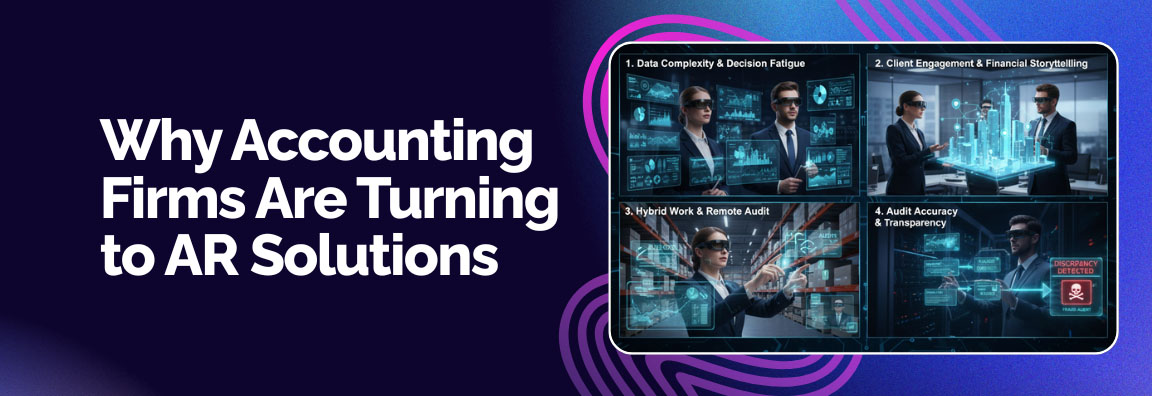
1. Data Complexity and Decision Fatigue
Modern accountants manage multi-dimensional datasets — revenue across geographies, multi-ledger consolidations, and compliance metrics. Traditional dashboards can’t convey this complexity clearly. AR provides spatial, layered visualizations that simplify understanding and reveal insights faster.
2. Client Expectations Have Evolved
Today’s clients expect more than static reports. They want interactive financial storytelling. With AR, accounting professionals can transform client meetings into immersive sessions where clients explore forecasts, models, and profitability in 3D space.
3. Hybrid Work Is Here to Stay
As accounting teams work remotely, AR bridges the gap by enabling virtual collaboration. Auditors can perform remote walkthroughs of client facilities using AR headsets, viewing real-time asset data and tagging compliance notes from anywhere.
4. Audit Accuracy and Transparency
Regulatory scrutiny is increasing, especially in sectors governed by SOX and GAAP. AR-powered audit trails can visualize transaction flows, detect discrepancies, and document evidence seamlessly.
5. Competitive Differentiation
Forward-thinking accounting firms like Deloitte and EY have already begun experimenting with immersive tech in training and client advisory. Early adopters of AR gain a clear edge by positioning themselves as innovative and client-centric.
Applications of Augmented Reality in Accounting
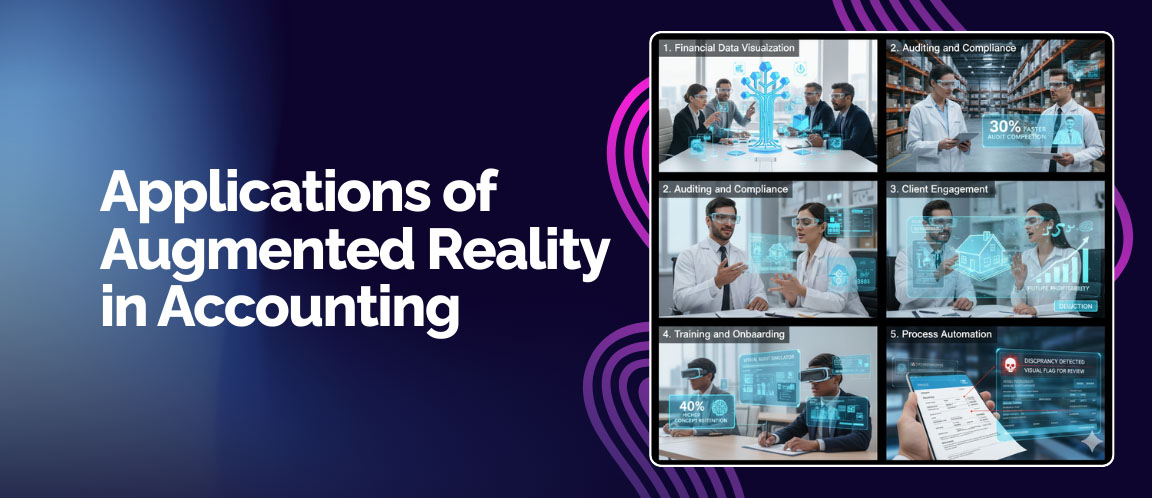
1. Financial Data Visualization
AR turns abstract financial data into interactive 3D environments. Accountants can explore income statements, cash flows, or variance analyses spatially — uncovering trends that static dashboards often hide.
Example:
A U.S.-based CPA firm uses AR dashboards during client strategy meetings. By projecting 3D profit and loss models into a conference space, stakeholders instantly understand the financial impact of strategic choices like pricing or cost reduction.
2. Auditing and Compliance
Auditors can leverage AR for on-site verification, enabling faster and more transparent checks.
Applications:
- Real-time asset tagging using AR overlays
- Interactive compliance walkthroughs
- Visual documentation of anomalies and reconciliations
- Collaboration between on-site and remote audit teams
According to Journal of Accountancy (2024), firms integrating AR-based verification tools reported up to 30% faster audit completion rates with fewer documentation gaps.
3. Client Engagement and Advisory Presentations
AR transforms how accountants communicate value. Clients can view projections, growth models, and tax implications through AR glasses or mobile apps — making financial data tangible.
Scenario:
During a tax planning session, an advisor uses an AR app to simulate the impact of investment decisions. The client can literally “see” how deductions, depreciation, and revenue changes affect future profitability.
4. Training and Onboarding
Accounting firms face a skill gap as they digitize. AR provides experiential learning that boosts retention and confidence.
Examples:
- New hires complete simulated audits in virtual AR environments.
- Accounting students learn complex topics like consolidation through 3D visualization.
Research published in Accounting Education Review (2025) found that learners using AR modules demonstrated 40% higher concept retention than those using traditional materials.
5. Process Automation and Error Reduction
AR can work alongside AI to automate manual tasks such as invoice validation and reconciliation.
- Point your phone at a paper invoice — AR extracts and cross-verifies amounts with ERP data.
- Discrepancies are visually flagged for review.
This visual approach minimizes human error and reduces review time.
Benefits of Augmented Reality in Accounting
A 2025 Gartner study found that immersive technologies improve data comprehension by 60% compared to 2D visuals — a game-changer for financial reporting and client presentations.
Challenges in Adopting AR for Accounting
Despite its promise, implementation requires strategic planning.
1. Integration with Legacy Systems
Most firms rely on mature ERPs like SAP, Oracle, or QuickBooks. AR tools must integrate seamlessly with these platforms to ensure data consistency.
2. Data Privacy and Security
Financial data is sensitive. Firms must ensure AR platforms comply with SOC 2, GDPR, and regional privacy frameworks. End-to-end encryption and user authentication are non-negotiable.
3. Implementation Costs
Hardware (e.g., AR headsets) and software development can be expensive. However, cloud-based and WebAR solutions are reducing entry barriers for mid-sized firms.
4. Change Management
Employees need training to adapt to immersive workflows. Early-stage adoption often faces cultural resistance.
5. Lack of Industry Standards
AR in accounting is still emerging. The absence of unified data and visualization standards means firms must customize their own frameworks.
How Accounting Firms Can Implement AR Step-by-Step
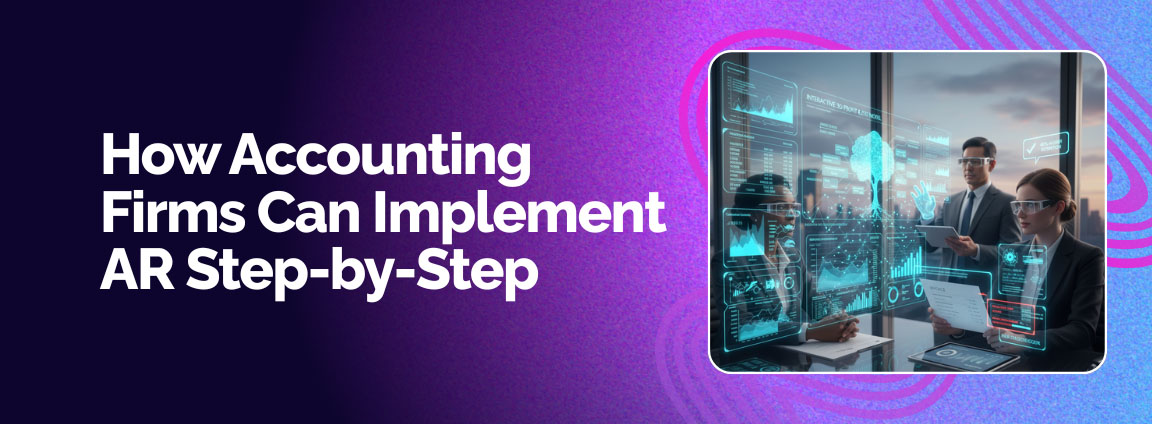
- Identify High-Impact Use Cases: Start small — visualize dashboards or audit workflows.
- Choose the Right Tools: Explore enterprise-grade AR SDKs such as ARCore (Google), ARKit (Apple), or WebAR solutions that don’t require headsets.
- Integrate with Existing Systems: Connect AR layers to ERP and CRM systems to ensure data accuracy.
- Train Staff and Clients: Host hands-on workshops for accountants, auditors, and clients.
- Measure ROI: Track time savings, client satisfaction, and reduced audit hours.
- Scale Gradually: Once pilot projects succeed, expand across departments.
Real-World Examples of AR in Finance
- Deloitte’s “Virtual Audit Lab” uses AR for immersive audit simulations and training auditors on complex controls.
- EY’s AR Tax Demonstrator helps clients visualize the impact of changing regulations through interactive overlays.
- PwC’s Digital Experience Hub experiments with AR in client presentations, turning financial data into 3D storytelling.
- SME Accounting Startups in California use mobile AR tools for real-time inventory valuation and reconciliation.
These examples prove that immersive technology is not futuristic — it’s already shaping how accountants communicate, collaborate, and add value.
The Future of Augmented Reality in Accounting
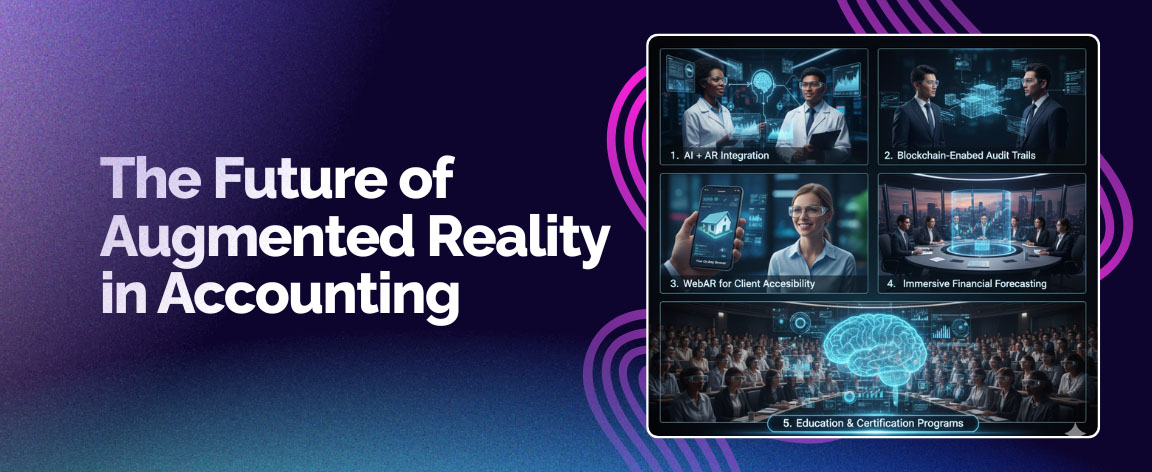
As AR becomes mainstream, several trends are emerging:
- AI + AR Integration: Artificial intelligence will power predictive insights inside AR dashboards, turning visualization into actionable intelligence.
- Blockchain-Enabled Audit Trails: Secure, immutable ledgers visualized in 3D space will revolutionize assurance practices.
- WebAR for Client Accessibility: Clients can access AR visualizations through browsers, removing the hardware barrier.
- Immersive Financial Forecasting: CFOs will use AR “war rooms” to test scenarios — adjusting variables and viewing impact projections instantly.
- Education & Certification Programs: Universities and CPA training institutes are beginning to adopt AR-based modules to prepare future accountants.
FAQs on Augmented Reality in Accounting
Q1. How is AR different from traditional data visualization?
AR adds a spatial dimension, letting accountants interact with 3D financial models rather than view static graphs.
Q2. What is the ROI of implementing AR in accounting?
Firms report improved data accuracy, faster audits, and higher client satisfaction — with ROI visible within 12–18 months for large-scale use.
Q3. Can small and mid-sized firms afford AR?
Yes. Web-based AR and tablet apps have made adoption much more affordable than custom headset-based systems.
Q4. Is AR safe for financial data?
With proper encryption, access control, and compliance standards, AR systems can be as secure as any enterprise-grade financial software.
Q5. How soon will AR become mainstream in accounting?
By 2028, experts expect at least 40% of accounting firms in the U.S. to adopt some form of AR in audit, training, or client advisory.
Conclusion: Partnering for a Future-Ready Accounting Experience
The integration of Augmented Reality in Accounting marks a turning point — where financial data is no longer confined to spreadsheets, but brought to life through immersive interaction. It allows accountants to work more precisely, collaborate more effectively, and deliver insights that clients can truly experience.
As this transformation accelerates, Trantor Inc. stands at the forefront of digital innovation, helping accounting businesses bridge the gap between traditional finance systems and next-generation immersive technology. By developing customized AR-powered applications, Trantor empowers firms to visualize financial data in 3D, conduct virtual audits, and engage clients through interactive analytics — all within secure, enterprise-grade frameworks.
Trantor’s expertise lies in crafting end-to-end AR ecosystems that seamlessly integrate with existing ERP, CRM, and compliance systems. The company combines AI-driven automation, real-time data visualization, and cloud-based scalability to deliver solutions that are not only innovative but pra
ctical for everyday accounting operations. Whether it’s enhancing audit accuracy, automating repetitive workflows, or transforming how financial insights are presented to clients, Trantor’s AR solutions help firms unlock measurable efficiency gains.
What sets Trantor apart is its consultative approach — collaborating closely with finance leaders, IT teams, and compliance officers to build AR solutions aligned with real-world accounting needs. The result is technology that enhances accuracy, deepens client trust, and positions firms for sustainable growth in an increasingly digital marketplace.
By partnering with Trantor Software, accounting firms can confidently step into the future of immersive financial management — where every number tells a story, every audit becomes transparent, and every client interaction is engaging and insightful.
Explore how Trantor Software can help your accounting firm leverage AR to enhance accuracy, efficiency, and engagement.
👉 Visit Trantor Inc. to learn more about custom AR development for finance and accounting.