Artificial Intelligence, zBlog
AI Agents vs RPA: What Is the Difference and Which Should Enterprises Use?
Team Trantor | Updated: July 21, 2026
What is the difference between AI agents and RPA?
RPA (Robotic Process Automation) automates repetitive, rule-based tasks by mimicking human clicks and keystrokes on existing software interfaces. AI agents use large language models to perceive, reason, and take actions autonomously across unstructured data and changing environments. RPA follows fixed rules and breaks when inputs change. AI agents adapt, handle exceptions, and make judgment calls without human intervention.
If you have been in an enterprise technology conversation recently, you have almost certainly heard RPA and AI agents mentioned in the same breath, often by vendors who are quietly repositioning their RPA products as “AI-powered” without much clarity on what actually changed. That ambiguity is costing enterprises real money in the form of wrong technology choices, failed automation projects, and missed productivity gains.
The core difference between AI agents and RPA is not a feature upgrade. It is a fundamental architectural difference in how each technology handles the thing that determines whether an automation project succeeds or fails in practice: exceptions. RPA works by following a predetermined script. When reality deviates from the script, the bot fails and a human has to intervene. According to Gartner research, 72 percent of RPA deployments require human intervention for exceptions on a regular basis. AI agents handle exceptions by reasoning through them. An AI agent that encounters an unexpected input format, an ambiguous request, or a situation outside its training distribution can apply judgment rather than generating an error ticket.
This guide answers the AI agents vs RPA question as an enterprise decision framework rather than a technology overview. It explains what each technology actually does, where each genuinely excels, how they compare on cost and ROI, the real-world use cases where each is the right choice, how the two work together in a hybrid architecture, and the decision criteria that should drive the choice for your specific automation context.
The single most useful reframe for evaluating AI agents vs RPA: the question is not which technology is better. It is which technology handles the exception profile of your specific automation target. Tasks with low exception rates and stable, structured inputs are excellent RPA candidates. Tasks with high exception rates, unstructured inputs, or judgment requirements are AI agent territory. Most enterprise automation portfolios should include both.
What Is RPA (Robotic Process Automation)?
Robotic Process Automation is software that automates repetitive, rule-based tasks by mimicking the actions a human would take in a software interface: clicking buttons, filling fields, copying and pasting data between applications, reading structured files, and submitting forms. An RPA bot is essentially a software script that interacts with the UI layer of existing applications, which means it works without any API access or backend integration.
The appeal of RPA when it was introduced in the early 2010s was that it could automate legacy system interactions without requiring any changes to the underlying software. Instead of building an API integration between a 20-year-old ERP and a modern CRM, an RPA bot could log into the ERP, copy the relevant data, and paste it into the CRM exactly the way a data entry clerk would, but at a much higher speed and without errors from manual transcription.
What RPA does well: high-volume, repetitive, structured-input tasks where the process is stable and exceptions are rare. Invoice processing, data migration between systems, payroll data entry, report generation from fixed data sources, and account provisioning are all tasks where RPA delivers genuine ROI quickly.
What RPA does not do well: any task that involves ambiguity, judgment, unstructured inputs, changing interfaces, or a meaningful exception rate. When the format of a supplier invoice changes slightly, the RPA bot fails. When a customer service request deviates from the expected script, the bot escalates to a human. When the UI of an application is updated, the bot stops working entirely until it is reconfigured.
THE MAINTENANCE REALITY: RPA bots are brittle. Every UI change, application update, or input format variation can break a deployed bot. Gartner estimates that enterprise RPA programs spend 30 to 40 percent of their total program cost on bot maintenance rather than new automation development. This maintenance burden is one of the primary drivers of enterprises evaluating AI agents as a more resilient alternative.
What Are AI Agents and How Do They Differ from RPA?
AI agents are software systems that use large language models to perceive their environment, reason about what action to take, and execute actions using tools and APIs. Unlike RPA bots that follow a predetermined sequence of steps, AI agents decide what to do at each step based on the current state of the task and the goal they have been given.
The practical consequence of this architecture difference is that AI agents handle the thing RPA cannot: exceptions. When an AI agent encounters an unexpected input format, it reads and interprets it. When a step in a process fails, the agent decides how to recover. When a user request is ambiguous, the agent asks a clarifying question or makes a reasonable inference. When a tool returns an unexpected result, the agent adapts its approach.
What AI agents do well: tasks that involve unstructured inputs such as natural language, documents, or emails, judgment calls that cannot be reduced to explicit rules, multi-step processes where the correct next step depends on the result of the current step, exception handling, cross-system orchestration where the agent decides which tools and APIs to call based on context, and tasks where the “right” output varies by case.
What AI agents do not do well (yet): very high-volume, purely transactional tasks where speed and cost per transaction are the primary metrics and no judgment is required. Processing a million identical, perfectly structured invoice fields is still cheaper and faster with RPA than with an LLM inference call for each transaction.
AI Agents vs RPA: Head-to-Head Comparison
| RPA (Robotic Process Automation) | AI Agents | |
|---|---|---|
| How it works | Mimics human UI clicks and keystrokes on existing interfaces | Perceives, reasons, and takes actions autonomously using LLMs and tools |
| Handles exceptions | Breaks and escalates to humans (72% of deployments affected) | Reasons through novel situations and adapts without human intervention |
| Setup requirement | Requires stable, unchanging UI and structured inputs | Works with unstructured data, natural language, changing environments |
| Maintenance burden | High: UI change breaks all dependent bots immediately | Lower: adapts to UI and format changes through reasoning |
| Task complexity | Simple, repetitive, rule-based, high-volume transactions | Complex, judgment-intensive, multi-step reasoning and decision-making |
| Best for | Invoice processing, data entry, report generation, legacy systems | Research, analysis, customer service, cross-system orchestration |
| RPA (Robotic Process Automation) | |
|---|---|
| How it works | Mimics human UI clicks and keystrokes on existing interfaces |
| Handles exceptions | Breaks and escalates to humans (72% of deployments affected) |
| Setup requirement | Requires stable, unchanging UI and structured inputs |
| Maintenance burden | High: UI change breaks all dependent bots immediately |
| Task complexity | Simple, repetitive, rule-based, high-volume transactions |
| Best for | Invoice processing, data entry, report generation, legacy systems |
| AI Agents | |
|---|---|
| How it works | Perceives, reasons, and takes actions autonomously using LLMs and tools |
| Handles exceptions | Reasons through novel situations and adapts without human intervention |
| Setup requirement | Works with unstructured data, natural language, changing environments |
| Maintenance burden | Lower: adapts to UI and format changes through reasoning |
| Task complexity | Complex, judgment-intensive, multi-step reasoning and decision-making |
| Best for | Research, analysis, customer service, cross-system orchestration |
The Evolution from RPA to AI Agents: Where Enterprise Automation Is Going
Understanding the AI agents vs RPA question requires understanding where each fits in the broader history of enterprise automation, because that history explains why enterprises have both technologies today and why neither replaces the other.
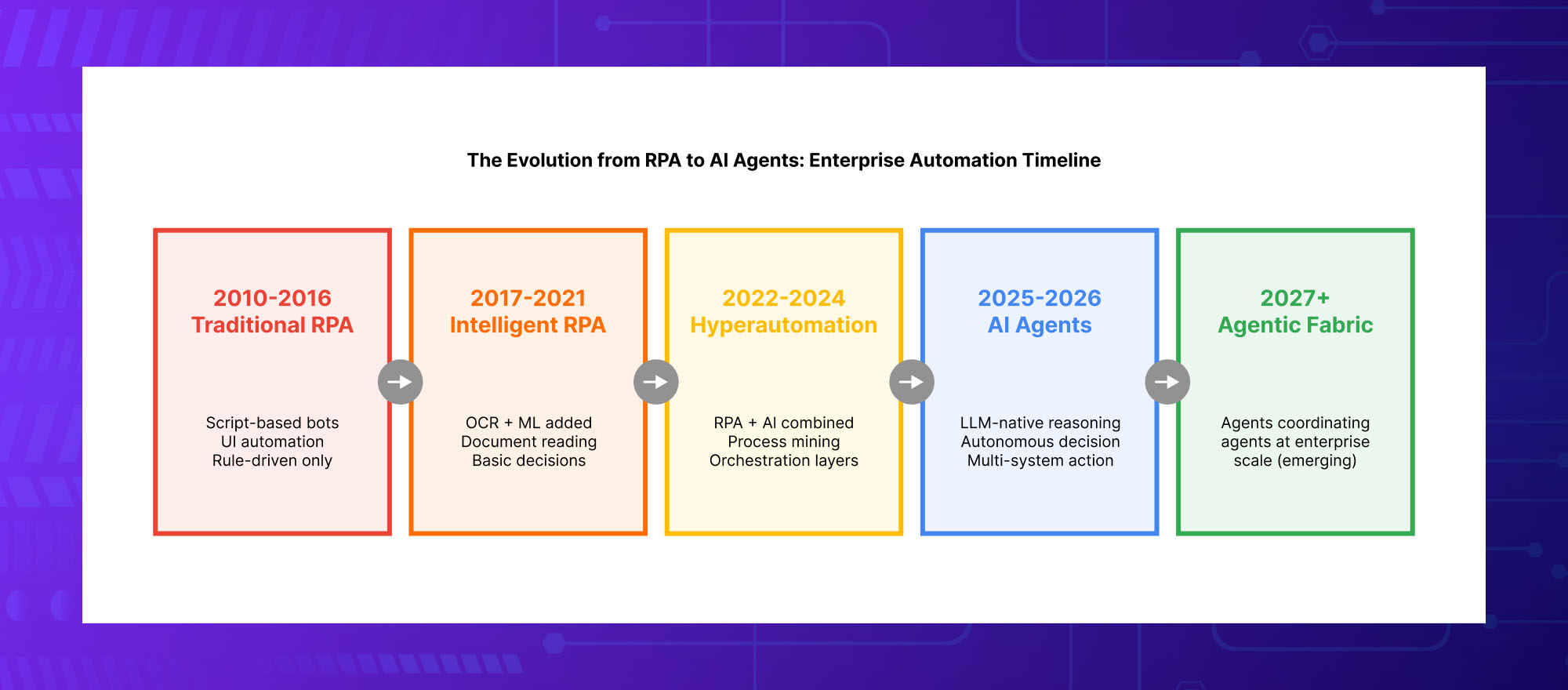
Traditional RPA, which dominated enterprise automation from roughly 2010 to 2016, was purely script-based. Bots followed exact sequences of UI interactions with no ability to adapt. The introduction of OCR and basic machine learning in Intelligent RPA (2017 to 2021) allowed bots to read unstructured documents and make simple decisions, extending their applicability without fundamentally changing the architecture.
Hyperautomation, the 2022 to 2024 era, brought RPA together with process mining, API integration, and AI components in orchestration layers that could route tasks between bots and humans more intelligently. Many RPA vendors positioned this as “AI-powered RPA,” but the underlying bots remained script-based. The AI layer improved routing and monitoring, not the fundamental bot behavior.
The AI agents era, which began in earnest in 2025 when LLM capabilities matured enough for enterprise task execution, introduced the first genuinely different automation architecture. AI agents do not follow scripts. They apply reasoning. This is a qualitative difference, not an incremental improvement, and it is why Forrester projects that 85 percent of enterprise automation use cases will shift toward AI agents by 2028.
When to Use RPA vs AI Agents: A Decision Framework
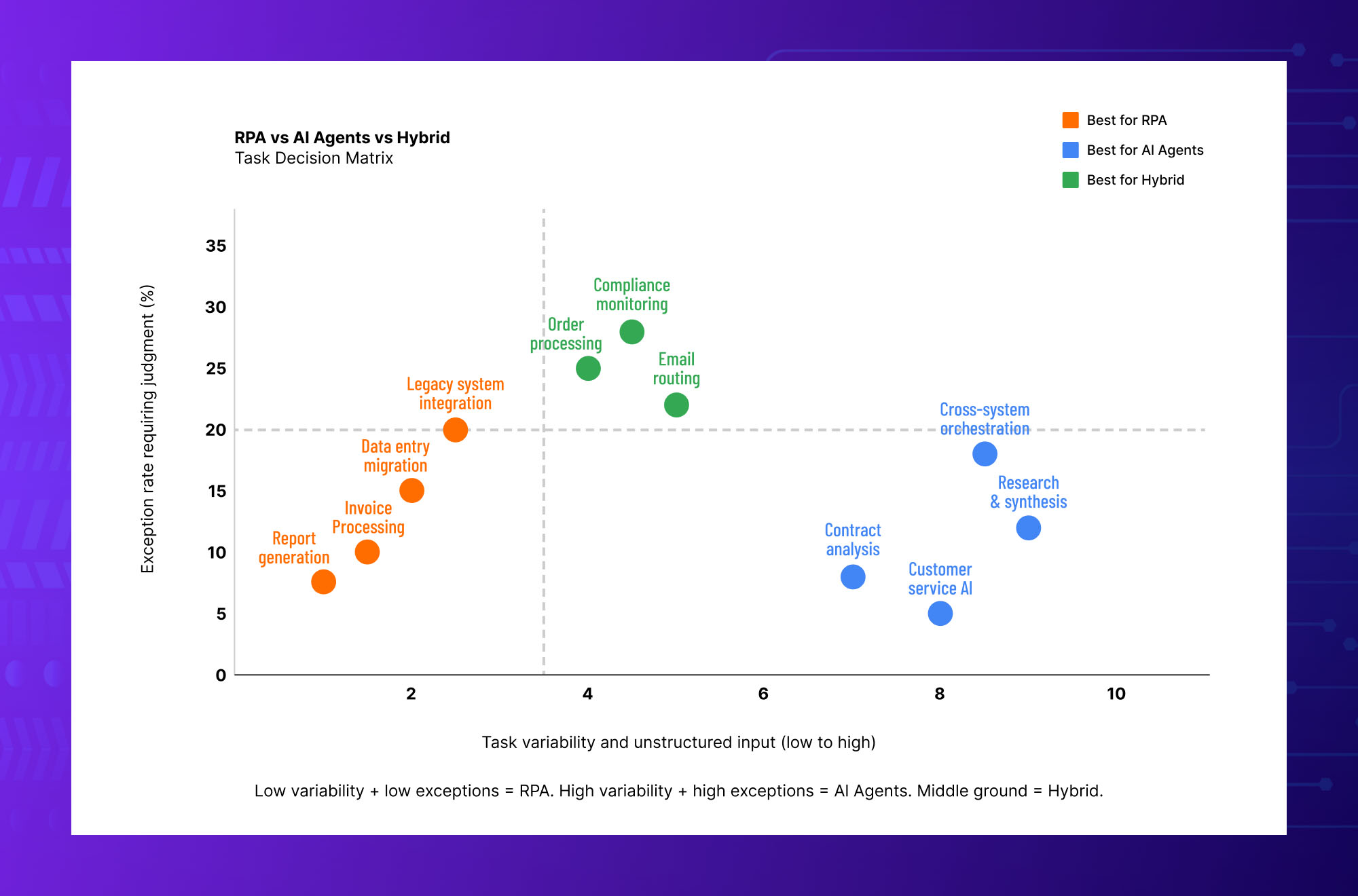
The decision between AI agents vs RPA for a specific automation target comes down to four questions: How structured are the inputs? How often do exceptions occur? How stable is the process? And what is the tolerance for LLM inference cost per transaction?
Choose RPA when all four conditions are true
The inputs are consistently structured and formatted. Exceptions occur in fewer than five percent of cases. The underlying applications and their interfaces are stable and rarely updated. The transaction volume is high enough that LLM inference cost per transaction would be prohibitive. Invoice processing at scale, payroll data entry, and database migration between systems with stable schemas are the canonical RPA use cases where this combination holds.
Choose AI agents when any of these conditions are true
The inputs include natural language, scanned documents, emails, or other unstructured content. Exceptions occur frequently enough that human review is already a significant cost in the current process. The process requires judgment about which action to take based on the content of the input rather than just routing based on a fixed field value. The task involves coordinating across multiple systems where the sequence of steps is not always predictable in advance. Customer service automation, contract analysis, research and synthesis tasks, and compliance monitoring all fit this profile.
Choose a hybrid architecture when tasks mix both profiles
Many enterprise automation use cases involve a high-volume structured core with meaningful exception volume around the edges. An order processing workflow might be 85 percent clean, structured transactions that an RPA bot handles perfectly, with 15 percent of orders involving customer notes, special requirements, or format variations that require judgment. The right architecture routes the 85 percent to RPA for cost efficiency and the 15 percent to an AI agent for exception handling, with the AI agent also managing the overall orchestration and monitoring.
Real Use Cases: AI Agents vs RPA in Practice
Cost and ROI: AI Agents vs RPA Financial Comparison
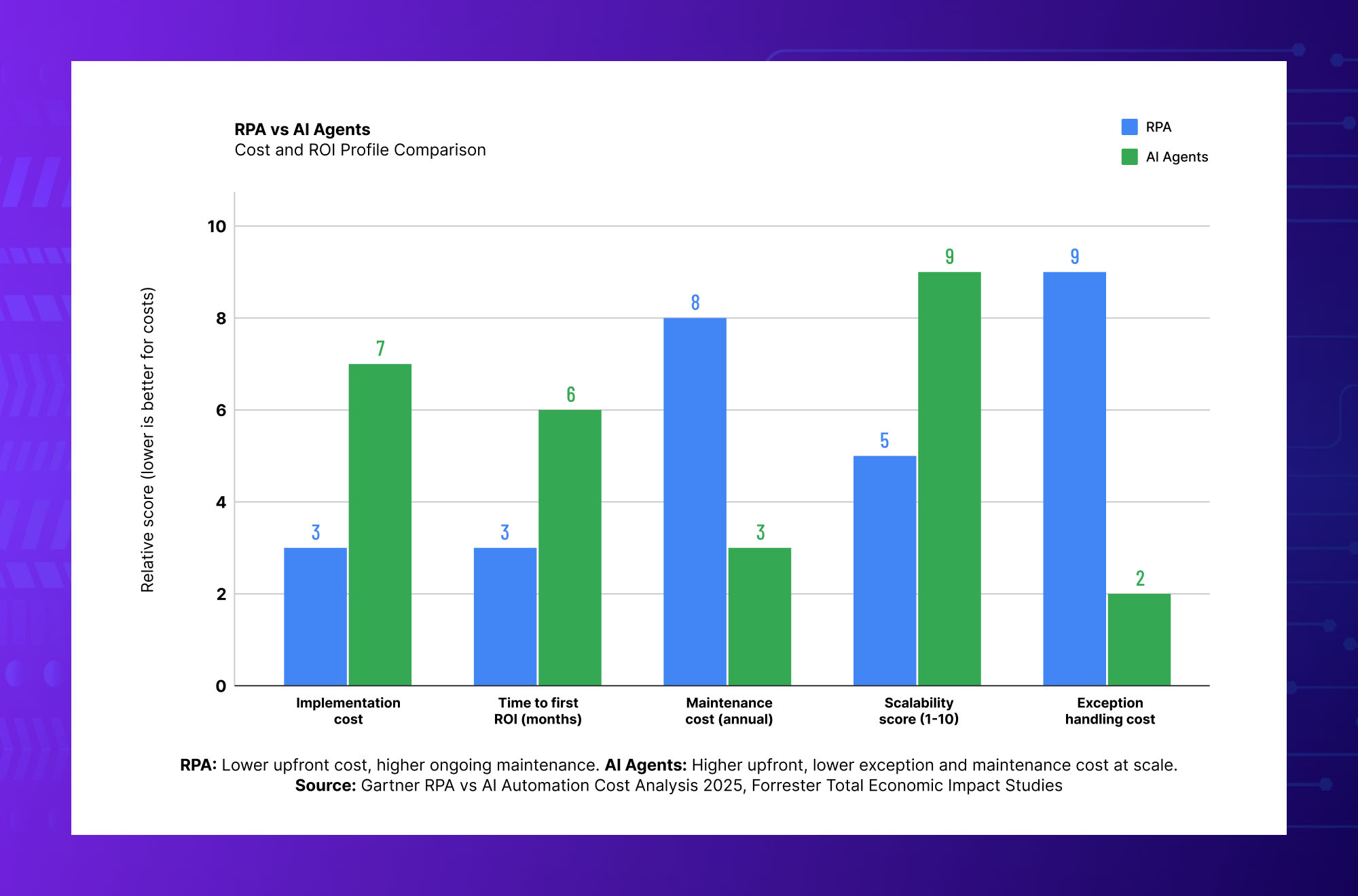
The AI agents vs RPA cost comparison depends heavily on which costs you include. RPA typically has a lower initial implementation cost and delivers ROI faster for the specific tasks it is designed for. But the fully loaded cost of RPA programs, including maintenance, exception handling, and bot reconfiguration after application updates, is significantly higher than the initial deployment cost suggests.
RPA cost profile: low implementation cost per bot for well-defined tasks, fast time to first ROI (typically 3 to 6 months for well-scoped bots), but high ongoing maintenance cost (30 to 40 percent of total program cost) and a high hidden cost in the human labor required to handle the exceptions that bots escalate. As application UIs change and RPA deployments scale, maintenance costs compound.
AI agents cost profile: higher initial development and infrastructure cost, longer time to first ROI (typically 6 to 12 months for production deployment), but significantly lower maintenance burden since agents adapt to input variation rather than breaking on it. LLM inference cost is the ongoing variable cost that RPA does not have. For high-volume purely transactional tasks, this inference cost can make AI agents more expensive than RPA per transaction.
The hybrid sweet spot: many enterprises find the best total cost of ownership in a hybrid architecture where RPA handles the high-volume, structured, low-exception core of each automation use case at low cost per transaction, while AI agents handle exceptions, orchestration, and the unstructured or variable portions that RPA cannot address reliably. This combination typically delivers lower total cost than either technology alone at scale.
ROI PLANNING NOTE: When building the business case for AI agents vs RPA, include the cost of human exception handling in the current RPA total cost. If 72 percent of your RPA deployments require human intervention for exceptions and each exception costs 5 to 15 minutes of an employee’s time, the fully loaded cost of your current RPA program is significantly higher than the bot licensing and maintenance line items suggest. AI agents that eliminate exception escalations frequently have a more favorable ROI than a narrow cost-per-bot comparison indicates.
Frequently Asked Questions About AI Agents vs RPA
AI Agents and RPA Are Not Competitors. They Are Partners in Enterprise Automation.
The AI agents vs RPA question is best understood not as a competition but as a complementary allocation problem. RPA has earned its place in enterprise automation over 15 years of production deployment. It handles high-volume, structured, stable tasks reliably and cost-effectively. Nothing about AI agents changes that.
What AI agents change is the set of automation tasks that are now tractable. The judgment-intensive, exception-heavy, unstructured-input automation targets that RPA has always struggled with are exactly the tasks that AI agents handle well. The enterprise that deploys both technologies in their appropriate roles, RPA for the structured core and AI agents for the intelligent periphery, is the one that captures the full productivity potential of enterprise automation rather than leaving the hard, high-value work to human labor because neither technology alone can handle it.
At Trantor, we help enterprises design automation architectures that put RPA and AI agents in the roles where each genuinely excels, rather than forcing one technology to do the job of the other. We bring both the deep AI agent development expertise and the practical experience of enterprise automation programs to help you make the right technology choice for each automation target, build the hybrid architectures that deliver the best total cost of ownership, and govern agentic AI systems that operate alongside existing RPA programs at scale. Whether you are evaluating your first AI agent deployment, modernizing an existing RPA program, or designing an enterprise automation strategy from scratch, we are ready to help.
Explore Trantor’s AI Automation and Agentic AI Services: Artificial Intelligence