Artificial Intelligence, zBlog

Open Source AI Models for Enterprise — The Complete 2026 Decision Guide

Enterprise AI models explained with insights into open source AI adoption, model selection and enterprise deployment strategies

Open source AI models are, technically, free. The weights are downloadable. The license says commercial use is permitted. You can spin one up on your own infrastructure tonight.

So why are so many enterprise AI programs running over budget in year one?

Because “free” is the acquisition cost, not the total cost. There is the GPU infrastructure. The DevOps hours. The security audit. The fine-tuning compute. The monitoring infrastructure. The engineering time spent chasing hallucinations that the proprietary model would have caught. Open source AI models are a powerful choice for the right organization deploying them in the right way. They are an expensive mistake for organizations that confuse “no API bill” with “no cost.”

This guide gives you the real picture — benchmarks, licensing fine print, TCO math, and a model-by-model breakdown covering every major open source family as of May 2026. Read the whole thing if you are making a strategic decision. Jump to the model cards if you already know what use case you are solving.

KEY STATISTICS — OPEN SOURCE AI 2026
0.3pt
MMLU benchmark gap between best open and proprietary model (was 17.5pt in 2024)
Swfte AI 2026
27×
Cheaper: DeepSeek R1 vs Claude Opus per million input tokens
AI Pricing Master 2026
~2M
Daily tokens = self-hosting breakeven vs proprietary API
AI Pricing Master 2026
60–83%
Cost reduction from hybrid open+proprietary routing architectures
AI Pricing Master enterprise routing guide

The Gap Between Open Source and Proprietary AI Effectively Closed in 2025

Something remarkable happened in 2025 that most enterprise AI strategies have not yet caught up with: the performance gap between open source and proprietary large language models effectively vanished.

The MMLU benchmark gap — the most widely used measure of general intelligence across AI models — narrowed from 17.5 percentage points to just 0.3 percentage points in a single year. What was once a multi-year frontier gap is now measured in weeks. Llama 4 Maverick outperforms GPT-4o on major benchmarks at $0.30 per million tokens. DeepSeek R1 delivers GPT-4-class reasoning for $0.55 per million input tokens — 27 times cheaper than Claude Opus. Qwen 3.5 from Alibaba quietly matches GPT-5.4 and Claude 4.6 Opus on several benchmarks, with download numbers that tell the real adoption story.
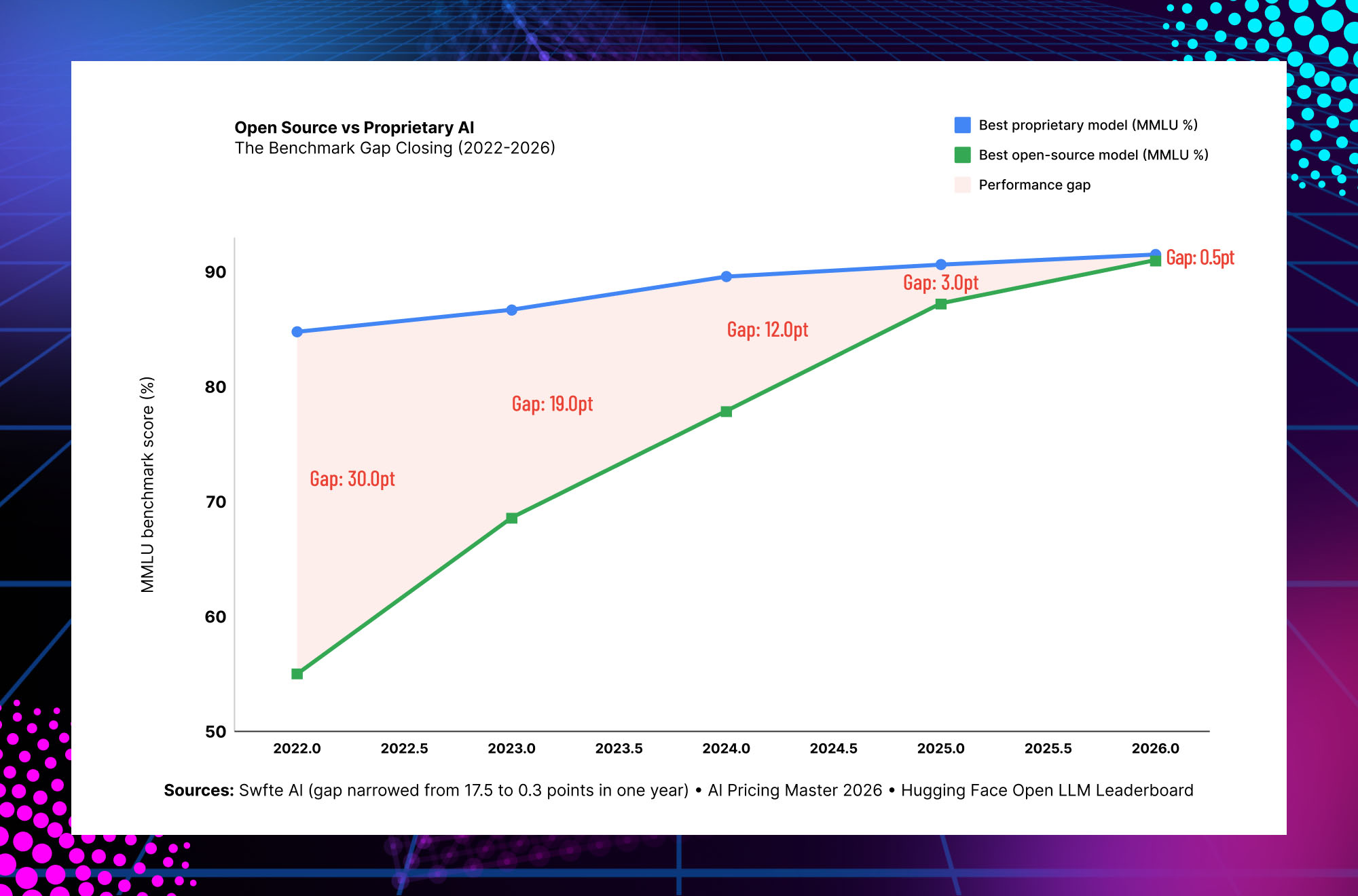
Open source versus proprietary AI benchmark comparison showing rapid performance improvements and narrowing capability gaps

For enterprise AI teams, this changes the decision calculus entirely. The question is no longer “can open source models perform well enough?” For 80–90% of real-world use cases, they can. The question is “what is the right deployment architecture for our specific workflow, compliance requirements, and cost structure?” That is a much more interesting question — and this guide answers it.

KEY INSIGHT:

Enterprises are now running open models for internal workloads and reserving proprietary API calls only for high-stakes, external-facing tasks. This hybrid pattern achieves 60–83% cost reductions without sacrificing quality on the tasks that matter most.

First: The Most Important Distinction Nobody Explains Properly

Before picking a model, you need to understand a terminology problem that is costing enterprises real money and, in some cases, creating legal exposure.

Three terms get used interchangeably in the press and on vendor sites. They mean very different things:

Open Source: Model weights + training code + training data documentation, all publicly available under an OSI-approved license. Very few major models actually meet this standard.

Open Weight: The model weights are downloadable. Training code and data may not be public. This is where most major models — Llama, Qwen, Gemma, DeepSeek, Kimi, GLM — actually sit. You can run them. You cannot reproduce the training.

Commercial Open Weight: Weights are downloadable and commercial use is explicitly permitted — but read the license. Some have revenue caps (Llama: restricted for organizations over 700 million monthly active users). Some have geographic restrictions. Some prohibit using the weights to train other models.

LICENSE TRAP:

The phrase “open source” on a model card does not mean Apache 2.0 or MIT. It may mean a custom license with user caps, geography restrictions, or prohibitions on derivative model training. If you are building a product on any of these models, your legal team needs to read the full license before your engineering team writes a line of code. The table below shows which models are genuinely safe for commercial deployment without restrictions.

Model License Commercial? Modify? Revenue cap? Safe for enterprise?
Qwen 3.5 (≤32B) Apache 2.0 ✓ Yes ✓ Yes ✗ None ✓ YES
DeepSeek R1 / V4 MIT ✓ Yes ✓ Yes ✗ None ✓ YES*
Mistral Large 3 Apache 2.0 ✓ Yes ✓ Yes ✗ None ✓ YES
Gemma 4 Apache 2.0 ✓ Yes ✓ Yes ✗ None ✓ YES
Llama 4 Meta Custom ✓ Yes ✓ Yes ⚠ 700M MAU ⚠ CHECK
GLM-5 MIT ✓ Yes ✓ Yes ✗ None ✓ YES*
Phi-4 MIT ✓ Yes ✓ Yes ✗ None ✓ YES
Qwen 3.5 (≤32B)
License Apache 2.0
Commercial? ✓ Yes
Modify? ✓ Yes
Revenue cap? ✗ None
Safe for enterprise? ✓ YES
DeepSeek R1 / V4
License MIT
Commercial? ✓ Yes
Modify? ✓ Yes
Revenue cap? ✗ None
Safe for enterprise? ✓ YES*
Mistral Large 3
License Apache 2.0
Commercial? ✓ Yes
Modify? ✓ Yes
Revenue cap? ✗ None
Safe for enterprise? ✓ YES
Gemma 4
License Apache 2.0
Commercial? ✓ Yes
Modify? ✓ Yes
Revenue cap? ✗ None
Safe for enterprise? ✓ YES
Llama 4
License Meta Custom
Commercial? ✓ Yes
Modify? ✓ Yes
Revenue cap? ⚠ 700M MAU
Safe for enterprise? ⚠ CHECK
GLM-5
License MIT
Commercial? ✓ Yes
Modify? ✓ Yes
Revenue cap? ✗ None
Safe for enterprise? ✓ YES*
Phi-4
License MIT
Commercial? ✓ Yes
Modify? ✓ Yes
Revenue cap? ✗ None
Safe for enterprise? ✓ YES

* Verify data residency and export compliance requirements before enterprise deployment.

If license flexibility is your top priority, Apache 2.0 and MIT are the cleanest options — Qwen 3/3.5 (≤32B), Mistral Large 3, Gemma 4, and Phi-4 all ship under these terms. No usage caps. No royalties. No geographic restrictions. You can fine-tune, modify, and commercially deploy without restriction.

The Real Cost Picture — API Pricing vs Self-Hosting TCO

“Open source is free” is the most expensive misconception in enterprise AI in 2026. Here is the actual cost structure, because this is where most organizations go wrong.
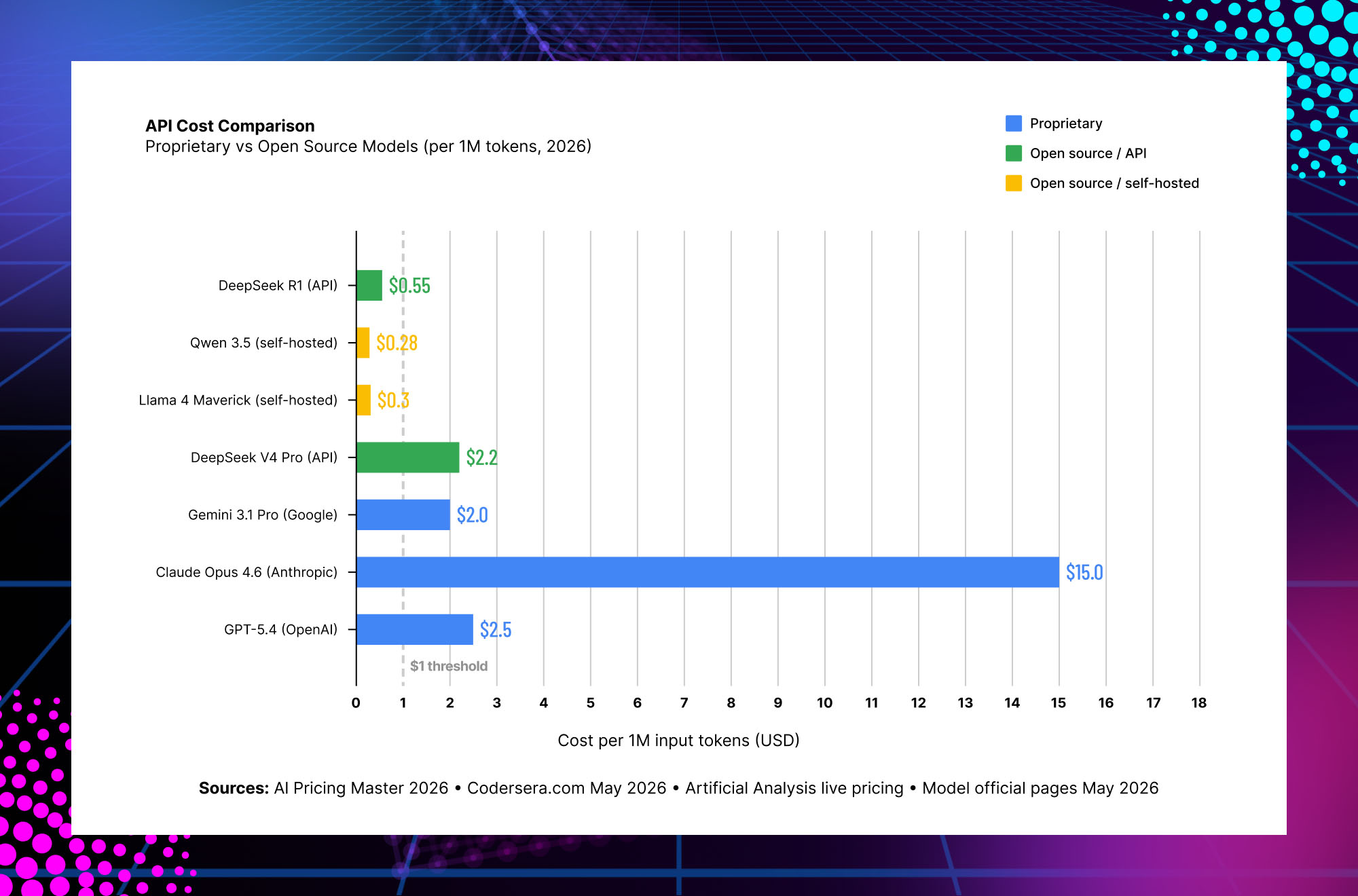
AI model API cost comparison highlighting pricing differences between proprietary and open source large language models

Option A: Use Open Source Models Via Third-Party API

Providers like Together.ai, Fireworks.ai, and Groq host open source models and charge per token. DeepSeek V4 Pro via API is ~$2.20/M tokens. Llama 4 Maverick via Groq is ~$0.30/M tokens. This is significantly cheaper than proprietary APIs ($2.50–15/M for GPT-5.4 or Claude Opus 4.6), and you get the cost benefits without the infrastructure burden. The tradeoff: your data still passes through a third party’s servers, which may not satisfy HIPAA, SOC 2, or GDPR requirements depending on where the servers are located.

Option B: Self-Host on Your Own Infrastructure

This is the “truly free” path — but only at sufficient scale. Self-hosting breaks even at approximately 2 million tokens daily when you account for GPU costs, DevOps overhead, monitoring, and ongoing maintenance. Below that threshold, proprietary APIs or third-party hosted open models typically win on total cost of ownership once you factor in engineering time.
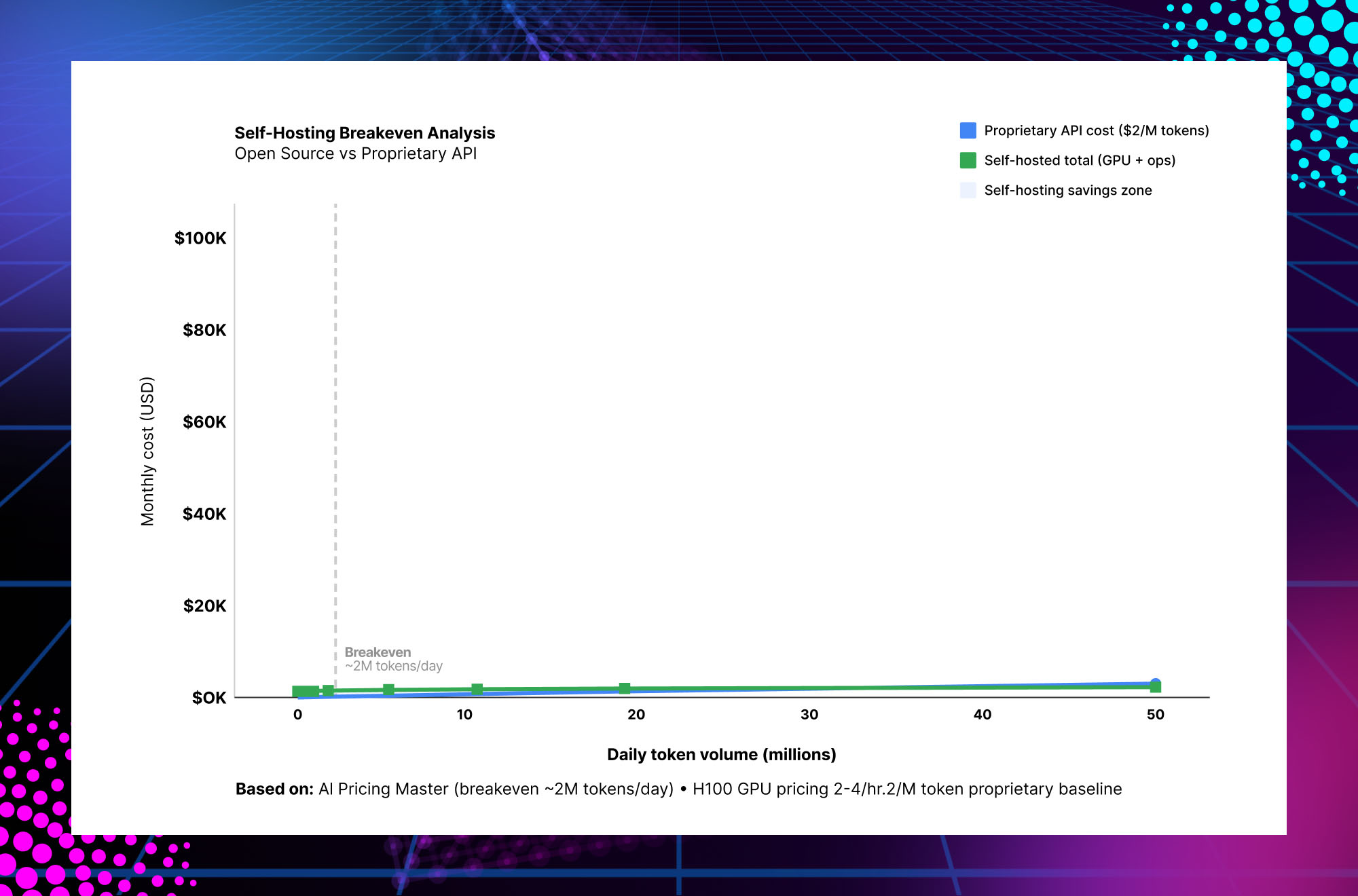
Self-hosted AI infrastructure cost analysis comparing open source model deployment with proprietary AI APIs

The math: an H100 GPU costs $2–4/hour on major cloud providers, or $1.85–2.20/hour on AMD MI300X. At 720 hours per month, your base GPU cost is $1,440–2,880 before DevOps, storage, monitoring, and engineering overhead. For a 7B model handling internal search queries at low-to-medium volume, you are paying more per query than a proprietary API. For a 70B model handling 10 million tokens per day of document processing, self-hosting can save $50,000+ per month versus GPT-4 pricing.

Option C: The Hybrid Architecture (What Most Mature Enterprises Use)

NVIDIA’s CEO stated it clearly: “Proprietary versus open is not a thing. It’s proprietary AND open.” The practical enterprise architecture in 2026 separates workloads by consequence and volume. High-consequence, external-facing tasks (customer communications, executive decision support, legal document analysis) go to proprietary frontier models. High-volume, internal tasks (knowledge search, document summarization, internal chatbots, code review) go to open source models — either self-hosted or via API. Companies implementing this hybrid routing are achieving 60–83% cost reductions without quality compromise on the tasks that actually matter to business outcomes.

The Data Sovereignty Question Every Enterprise Needs to Answer

In 2025, Chinese AI organizations steered heavily into open source. The number of competitive Chinese organizations releasing models on Hugging Face skyrocketed. Baidu went from zero releases on the Hub in 2024 to over 100 in 2025. ByteDance and Tencent each increased releases eight to nine times. Chinese open-source AI models jumped from 1.2% of global usage in late 2024 to nearly 30% by end of 2025.

DeepSeek, Qwen, Kimi, and GLM are among the highest-performing models by benchmark. They are also models developed by organizations subject to Chinese data laws — including the National Intelligence Law, which requires organizations to cooperate with Chinese intelligence operations when requested.

DATA SOVEREIGNTY RISK:

When DeepSeek or Qwen models are used via their official cloud APIs, user data routes through mainland China — up to 100,000 words per request. This is a material risk for enterprises in defense, government, healthcare, financial services, and any organization handling personal data subject to GDPR. However: the model weights themselves have no networking capability. Running DeepSeek or Qwen weights on your own infrastructure, in your own cloud region, means your data never leaves your servers. The risk is the API, not the weights. Know which deployment mode you are using.

The practical guidance: for regulated industries or organizations with government clients, either run Chinese model weights on your own EU/US infrastructure with a model-swappable architecture, or use European models (Mistral) or US models (Llama, Gemma, Phi) for sensitive workloads. For internal, non-sensitive workloads where cost efficiency is the priority and data never touches the Chinese cloud APIs, DeepSeek and Qwen weights on your own infrastructure are genuinely strong options.

The 8 Best Open Source AI Models for Enterprise in 2026

Every model below has been evaluated for enterprise deployment — not just benchmark scores, but licensing, hardware requirements, community support, and real production viability. Models are grouped by use case fit, not benchmark rank.

#1 — DeepSeek V4 Pro 685B total / 49B active (MoE) · 1M token context · MIT license · $2.20/M tokens API

✦ Best for: Coding, agentic workflows, technical reasoning, high-volume RAG pipelines

📋 License: MIT license on weights. Code is MIT. Distilled model variants use Qwen/Llama base — check separately. API routes through China — use weights on own infra for sensitive data.

✓ Strengths: SWE-bench Verified leading scores. 1M token context for full codebase RAG. Strongest coding performance among open models. MIT license on weights is among the cleanest in class.

✗ Limitations: API data sovereignty concern (see above). 685B full model requires significant GPU infrastructure — most enterprises use distilled variants or third-party API. Not suitable for regulated industries via official API.

★ Verdict: ★★★★★ for technical workloads on own infrastructure. The benchmark leader for coding and reasoning. Data sovereignty concern is real but solvable with self-hosting on domestic infrastructure.

#2 — Qwen 3.5 (Apache 2.0 variants) 235B-A22B (MoE flagship) · 128K context · Apache 2.0 (≤32B) · $0.28/M tokens API

✦ Best for: Multilingual enterprise apps, commercial products, fine-tuning without restrictions

📋 License: Apache 2.0 for models up to 32B. Larger sizes use Tongyi Qianwen license — generally permissive commercially but not OSI-approved. Check specific model card before production deployment.

✓ Strengths: Strongest multilingual coverage: 201 languages and dialects. Apache 2.0 on smaller models is the cleanest enterprise license available. 235B-A22B runs on MacBook with 192GB. Strong fine-tuning ecosystem.

✗ Limitations: Data sovereignty consideration for API use (same as DeepSeek — weights fine on own infra). Larger model licensing requires review. Benchmark scores self-reported in some categories.

★ Verdict: ★★★★★ for multilingual and commercial applications needing clean licensing. The default recommendation for teams that need Apache 2.0 freedom and strong performance without frontier pricing.

#3 — Mistral Large 3 675B total / 41B active (MoE) · 256K context · Apache 2.0 · $1.50/$7.50 per M in/out tokens

✦ Best for: GDPR-sensitive deployments, EU data sovereignty, multilingual European enterprise apps

📋 License: Apache 2.0. No restrictions on commercial use, fine-tuning, or derivative models. Voxtral speech model (March 2026) is also fully open under Apache 2.0.

✓ Strengths: Cleanest enterprise license — Apache 2.0, no caveats. European jurisdiction — strongest GDPR story of any major model. Strong multilingual (80+ languages). Devstral coding variant scores 72.2% SWE-bench. Model weights stay in EU when deployed on EU infrastructure.

✗ Limitations: Higher cost than Chinese models at equivalent performance. Smaller community and fine-tuning ecosystem than Llama or Qwen. Devstral (coding) is non-commercial license — separate from Large 3.

★ Verdict: ★★★★★ for EU-based enterprises and regulated industries. The only serious choice when GDPR compliance, European data sovereignty, and Apache 2.0 freedom all need to be true simultaneously.

#4 — Google Gemma 4 (26B Dense / 26B A4B MoE) 26B dense or 26B A4B MoE · 256K context · Apache 2.0 · Free (Ollama/HuggingFace)

✦ Best for: Local deployment on enterprise laptops and workstations, multimodal tasks, edge inference

📋 License: Apache 2.0. Zero commercial restrictions. Available on Hugging Face, Ollama, Kaggle, and Google AI Studio from day one of release.

✓ Strengths: 20x coding improvement over Gemma 3 (Codeforces ELO: 110 → 2,150). Natively multimodal (text, image, video, audio). 26B Dense: runs in 14GB on consumer hardware at 85 tokens/second. Global #3 on Arena AI leaderboard among open models. Free Colab notebooks available.

✗ Limitations: Google ecosystem alignment — model choices may favor Google infra. Larger MoE variant benefits are tied to specific hardware. Video understanding is newer and less battle-tested.

★ Verdict: ★★★★★ for local deployment and multimodal use cases. The best option for enterprises needing on-device inference without data leaving the device — phones, laptops, edge hardware.

#5 — Meta Llama 4 (Scout / Maverick) Scout: 109B/17B active · 10M token context │ Maverick: 400B/17B active · 1M context · Meta Custom License

✦ Best for: Long-context workloads, large codebase RAG, general-purpose US enterprise applications

📋 License: Meta Community License. Commercial use permitted for organizations under 700 million monthly active users (virtually all enterprises qualify). Cannot use to train other foundation models.

✓ Strengths: Scout: 10 million token context window — unmatched for full-codebase or full-document-archive RAG. Maverick: 80.5% MMLU-Pro, outperforms GPT-4o. Single H100 deployment possible. Largest open model ecosystem (tooling, fine-tunes, deployment guides).

✗ Limitations: Llama 4 launch was rough (April 2025) — Qwen and DeepSeek took mindshare. Cannot use to train derivative models (restricts the fine-tuning-and-release workflow). Coding scores trail DeepSeek V4 significantly.

★ Verdict: ★★★★☆ for US enterprises needing the largest ecosystem and longest context window. Scout’s 10M context is genuinely unmatched for massive RAG pipelines. Choose Maverick for general tasks, Scout for long-context.

#6 — Kimi K2.6 (Moonshot AI) ~1.1T total (MoE) · 256K context (extendable to 1M) · Modified MIT license

✦ Best for: Agentic coding, tool use, long-horizon multi-step workflows, visual tasks

📋 License: Modified MIT license per official model card. Confirm current license at Hugging Face before production deployment — Moonshot updates model cards periodically.

✓ Strengths: State-of-the-art long-horizon coding and agentic performance. LiveBench Coding Average 78.57 — leads open-source set. Powers Cursor’s Composer 2. Strong function calling and structured output. Supports image and video input. Built specifically for agentic “build things” workflows.

✗ Limitations: Data sovereignty consideration for API use. Moonshot is Chinese lab — same data routing considerations as DeepSeek/Qwen. Video understanding experimental. Requires significant GPU for full model. Smaller deployment ecosystem than Llama/Qwen.

★ Verdict: ★★★★★ for agentic coding on own infrastructure. If you are building internal coding agents and can run the model on your own GPU cluster, K2.6 leads the open-source field on the tasks that matter.

#7 — Microsoft Phi-4 (14B) 14B parameters · 128K context · MIT license · Runs on RTX 4080 (16GB)

✦ Best for: Edge deployment, enterprise laptops, low-latency inference, privacy-first internal tools

📋 License: MIT license. Full commercial freedom. Part of the Phi series — Phi-3 and Phi-4 are Microsoft Research models with strong “textbook quality” training methodology.

✓ Strengths: GPT-3.5 class performance at 14B parameters — remarkable efficiency. Runs on a single consumer GPU (RTX 4080). MIT license with zero restrictions. Strong reasoning relative to size. Ideal for enterprises that need on-device inference without cloud dependency.

✗ Limitations: Cannot compete with 70B+ models on complex reasoning. Not suitable for coding-heavy agent workflows where Kimi or DeepSeek excel. Smaller multilingual coverage than Qwen or Mistral.

★ Verdict: ★★★★☆ for resource-constrained or privacy-first deployments. The right choice when your primary constraint is “the model must run on a laptop” or “nothing leaves the endpoint.” Outperforms its size class significantly.

#8 — GLM-5 / GLM-5.1 (Zhipu AI) 355B+ parameters (MoE) · MIT license · SWE-bench Verified: ~77.8%

✦ Best for: Long-context agentic coding, complex reasoning, high-stakes software engineering tasks

📋 License: MIT license on GLM-5 and GLM-5.1. Same data sovereignty considerations as other Chinese lab models for API use — weights on own infrastructure resolve this.

✓ Strengths: Coding Average 73.64 (GLM-5) and 75.37 (GLM-5.1) on LiveBench — among the highest open-source coding scores available. MIT license is cleanest possible. Strong on long-context tasks. Competitive with DeepSeek V4 Pro on agentic coding specifically.

✗ Limitations: Smaller deployment ecosystem than the major Western or Chinese front-runners. Fewer quantized variants available. Data sovereignty risk via API. Less community fine-tuning infrastructure.

★ Verdict: ★★★★☆ for enterprises willing to run Chinese model weights on own infrastructure and prioritizing top coding performance with MIT freedom. Underrated relative to its benchmark performance.

How the Model Families Compare — 6 Enterprise Dimensions
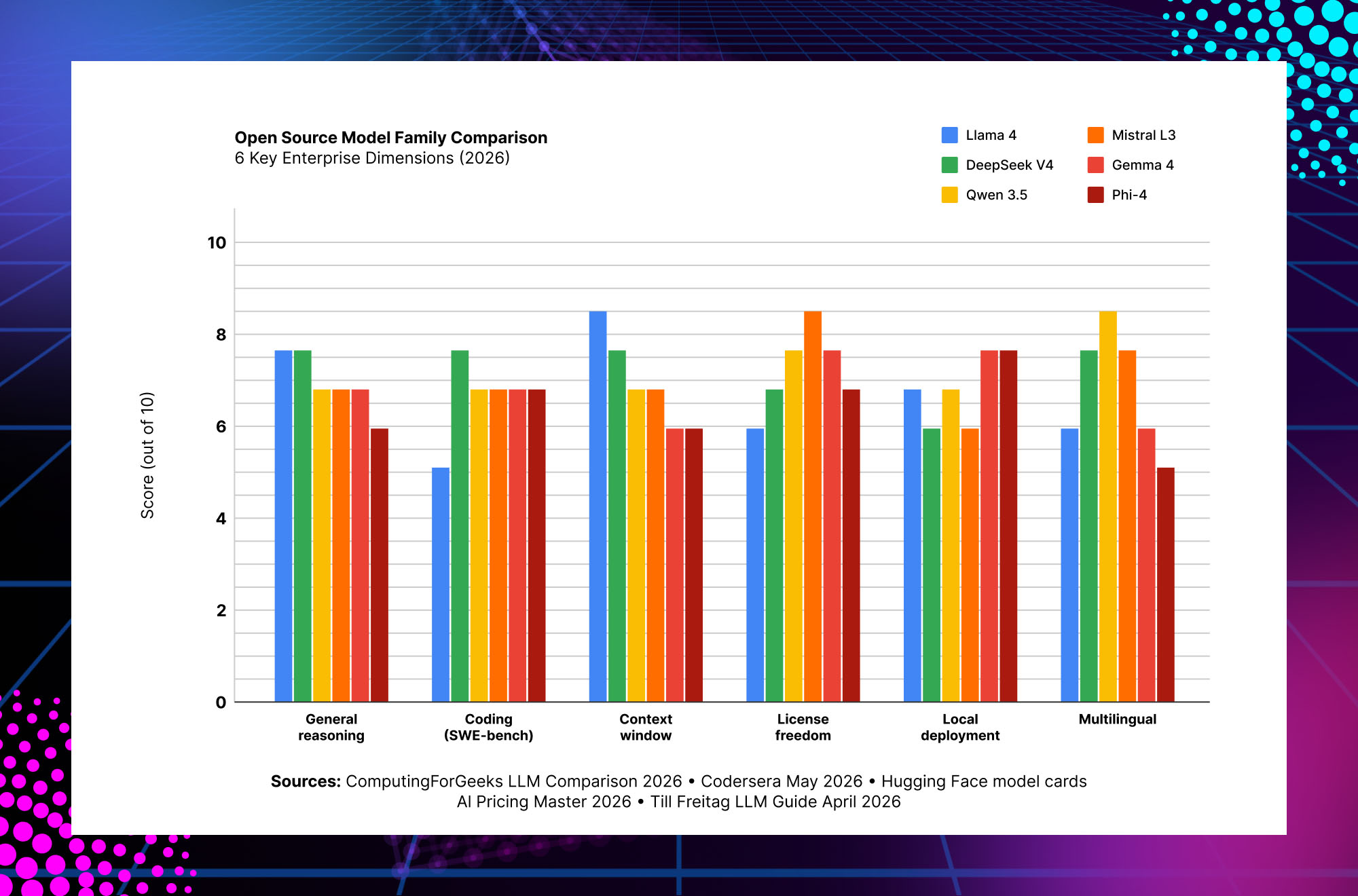
Enterprise open source AI model comparison across reasoning, coding, deployment flexibility and multilingual performance

The chart above scores each model family on six dimensions that matter for enterprise deployment: general reasoning (MMLU-class benchmarks), coding ability (SWE-bench Verified), context window (raw token capacity), license freedom (permissiveness for commercial use), local deployment practicality (hardware requirements vs performance), and multilingual coverage.

The key enterprise takeaway: no single model dominates every dimension. Qwen 3.5 leads on multilingual and license freedom. DeepSeek V4 leads on coding. Llama 4 leads on context window. Mistral Large 3 leads on license freedom plus data sovereignty. Gemma 4 leads on local deployment practicality. Building the right stack means understanding which dimensions matter most for your specific workloads — and accepting that a hybrid of two or three models likely outperforms any single model choice.

Use Case → Model Decision Matrix

Stop searching for “the best open source model.” The right question is always “the best model for this specific use case, compliance requirement, and deployment context.”

Use Case Recommended Model Deployment Pattern
High-volume internal search / document summarization DeepSeek V4 Flash or Qwen 3.5 30B Open-weight API or self-hosted
Customer-facing outputs
(tone, accuracy critical)
Claude Opus 4.6 / GPT-5.4 Proprietary API
Code review / coding agent
(self-hosted, air-gapped)
Devstral / Kimi K2.6 / GLM-5.1 Self-hosted on enterprise GPU
Regulated industry
(HIPAA/GDPR, no data leaving)
Mistral Large 3 / Gemma 4 On-prem deployment, EU/US infra
Multilingual / global apps
(200+ languages)
Qwen 3.5 (Apache 2.0) API or self-hosted

Based on TIMEWELL/NVIDIA enterprise framework · Codersera 2026 · AI Pricing Master enterprise routing guide

High-volume internal search / document summarization
Recommended Model DeepSeek V4 Flash or Qwen 3.5 30B
Deployment Pattern Open-weight API or self-hosted
Customer-facing outputs (tone, accuracy critical)
Recommended Model Claude Opus 4.6 / GPT-5.4
Deployment Pattern Proprietary API
Code review / coding agent (self-hosted, air-gapped)
Recommended Model Devstral / Kimi K2.6 / GLM-5.1
Deployment Pattern Self-hosted on enterprise GPU
Regulated industry (HIPAA/GDPR, no data leaving)
Recommended Model Mistral Large 3 / Gemma 4
Deployment Pattern On-prem deployment, EU/US infra
Multilingual / global apps (200+ languages)
Recommended Model Qwen 3.5 (Apache 2.0)
Deployment Pattern API or self-hosted

Based on TIMEWELL/NVIDIA enterprise framework · Codersera 2026 · AI Pricing Master enterprise routing guide

The three-tier enterprise framework that practitioners in the field recommend: at the top, proprietary frontier models (Claude Opus, GPT-5.4, Gemini 3.1 Pro) for customer-facing work and top-tier reasoning. In the middle, open-weight large models (Mistral Large 3, Qwen 3.5, Llama 4, DeepSeek V4 — those satisfying your regulatory requirements) on-premises or in a domestic cloud for fast, cheap internal processing. At the bottom, small distilled models (Phi-4, Gemma 4, Qwen3-7B) for edge inference, personal productivity tools, and low-latency applications.

Hardware Requirements — What You Actually Need to Self-Host
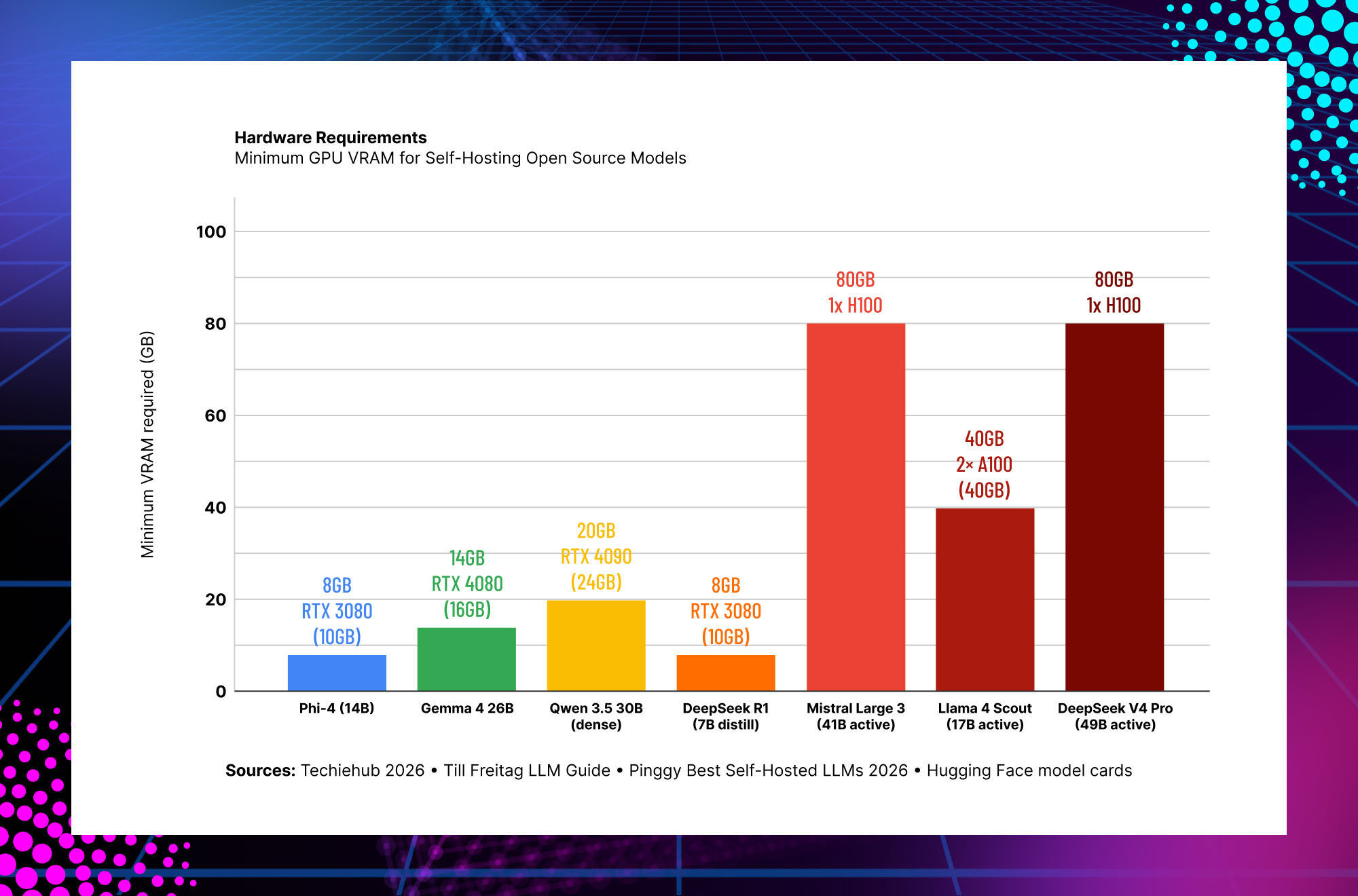
GPU hardware requirements for self-hosting open source AI models including VRAM needs and deployment planning considerations

The good news for mid-market enterprises: the inference tooling has matured dramatically. Ollama, vLLM, and LM Studio now run 7B–14B models on a single consumer GPU with acceptable latency. For a team of 20 developers using an internal coding assistant based on a 14B model, an RTX 4090 server ($2,000–3,000 hardware cost) can serve the entire team. vLLM with PagedAttention is the production-grade serving solution for larger models, supporting Llama, Qwen, Mistral, DeepSeek, and most major architectures.

Quick decision rule: For models under 14B active parameters, a single consumer GPU (RTX 4080/4090) works for team-scale deployment. For 40B+ active parameters (Mistral Large 3, Llama 4 Maverick in full form), you need data center GPUs — at minimum one H100 or two A100s. For full MoE models at 685B+ (DeepSeek V4 Pro), most enterprises use quantized variants or third-party API hosting rather than full self-hosting.

Frequently Asked Questions

Q: Are open source AI models actually as good as GPT-4 now?
For 80–90% of real-world use cases, yes. The MMLU benchmark gap between the best open source and proprietary models narrowed from 17.5 percentage points to just 0.3 in a single year. Llama 4 Maverick outperforms GPT-4o on major benchmarks at $0.30/M tokens. DeepSeek R1 matches OpenAI’s o1 on reasoning benchmarks at a fraction of the cost. The remaining gaps are in instruction-following polish for edge cases, the very latest proprietary reasoning models (GPT-5.4, Claude Opus 4.6), and multimodal capabilities — particularly video. For most enterprise internal workloads, open source models are more than sufficient.
Q: What is the difference between open source and open weight AI models?
Open source means weights + training code + training data are all publicly available under an OSI-approved license. Open weight means the model weights are downloadable for use and often fine-tuning, but training code or data may not be public. Most major “open source” AI models — Llama, Qwen, DeepSeek, Gemma, Kimi, GLM — are actually open weight, not open source by the strict definition. For enterprise purposes, the license is what matters most: Apache 2.0 and MIT licenses give you full commercial freedom. Custom licenses (like Llama’s Meta Community License) may have restrictions. Always read the license on the specific model card, not just the family’s general reputation.
Q: Is it safe to use DeepSeek or Qwen in my enterprise?
It depends on how you deploy them. If you use DeepSeek or Qwen via their official cloud APIs, your data routes through mainland China — a material risk for organizations in regulated industries, defense, government, or handling GDPR-subject personal data. If you run the model weights on your own infrastructure (your cloud region, your servers), the weights have no networking capability and your data never leaves your environment. The risk is the API, not the weights. Enterprises in sensitive sectors can benefit from the performance of these models by self-hosting, while organizations in less sensitive sectors may comfortably use the APIs after appropriate legal review.
Q: When does self-hosting open source AI make financial sense?
Self-hosting typically breaks even versus proprietary APIs at approximately 2 million tokens per day, accounting for GPU costs, DevOps overhead, and maintenance. Below that threshold, proprietary APIs or third-party hosted open models usually win on total cost of ownership. Above that threshold, self-hosting can save $50,000+ per month for high-volume workloads. The hybrid approach — self-host for high-volume internal tasks, use proprietary APIs for high-stakes external-facing tasks — achieves 60–83% cost reductions while maintaining quality where it matters.
Q: Which open source AI model has the cleanest enterprise license?
Apache 2.0 and MIT are the cleanest licenses — no usage caps, no revenue limits, no geographic restrictions, no prohibition on training derivative models. Models with these licenses: Qwen 3.5 (models ≤32B), Mistral Large 3, Gemma 4, Phi-4, DeepSeek R1/V4 (MIT on weights — though distilled variants based on Qwen/Llama require checking those underlying licenses), GLM-5 (MIT). Llama 4 uses Meta’s Custom Community License — commercial use is permitted for organizations under 700M monthly active users, but you cannot use the weights to train other foundation models. If building a product that will itself distribute AI capabilities, Apache 2.0 or MIT is significantly safer than Meta’s license.
Q: What GPU do I need to run a 70B open source model?
A 70B dense model (like older Llama 2/3 variants) requires approximately 140GB of VRAM at full precision (FP16), meaning two A100 80GB GPUs or equivalent. However, most enterprise deployments use quantized variants: at 4-bit quantization, a 70B model fits in ~35GB VRAM — a single A100 40GB. Modern MoE models are more efficient: Llama 4 Maverick (400B total, 17B active) can run on a single H100, because only 17B parameters are active per token. For teams just starting: Gemma 4 26B Dense at 14GB on an RTX 4090 is the most practical entry point for a capable model on consumer hardware.

The Bottom Line: Open Source AI Is Ready for Enterprise. The Question Is Your Architecture.

The “open source AI models vs proprietary” debate is settled in 2026. The models are ready. The tooling is mature. The licensing options include genuinely permissive commercial terms. The benchmark gap has closed to rounding error on most tasks.

What is not settled — and what will determine which enterprises extract real value from open source AI versus which ones run over budget — is the deployment architecture. Which workloads go to self-hosted open models, which go to third-party hosted open models, and which go to proprietary APIs. How the data sovereignty risk of Chinese model APIs is managed. Which license your legal team has actually reviewed. Whether your token volume justifies self-hosting infrastructure or whether a third-party API is cheaper.

These are engineering and strategy questions, not technology questions. The technology is ready. The question is whether your organization has the capability to deploy it correctly.

At Trantor (trantorinc.com), we help enterprise organizations design and implement open source AI architectures that are technically sound, cost-efficient, and compliant with their specific regulatory requirements. From model selection and license review through infrastructure design, fine-tuning pipelines, and hybrid routing architectures — we have done this in production across healthcare, financial services, technology, and enterprise software organizations. If you are evaluating open source AI for the first time, scaling a pilot to production, or building the governance infrastructure to manage a mixed open source and proprietary AI portfolio — that is the work we are built for.

Open source AI architecture consulting for model selection, infrastructure design, compliance and hybrid AI deployment